Tampilkan postingan dengan label perennial. Tampilkan semua postingan

Selasa, 17 Mei 2016

Purple asparagus

I bought and planted some seeds of purple asparagus (Asparagus officinalis) before we moved here.  I think I got about 10 seeds in all, which is not many but at that time purple asparagus could only be bought from one place so I didnt have a great deal of choice if I wanted to grow it.

The seeds were small, black and unremarkable.  I soaked them in water overnight and planted them, then waited for something to happen.  From those seeds only 3 germinated, it was very exciting.  At that time I knew of no one who had ever grown asparagus from seed so was pretty much on my own to figure how to grow them.  I have grown many things over the years which people have told me are impossible to grow, so this didnt daunt me.

Out of those 3 tiny seedlings grew, then slugs or snails killed 2 of them one night.  After noticing the loss I quickly put crushed eggshell all around the last survivor to help protect it.  That one seedling was not killed but did sustain some snail damage from time to time and needed the crushed egg shell placed around it pretty often.

This one tiny seedling grew slowly, it died down each winter as asparagus must, and grew back larger each Spring.  Each Spring the snails would hammer it and I would protect it with egg shells.

Then it was dug up and moved here with us.  Considering that we moved in the height of summer the plant did not enjoy this move and its growth was slowed but it did not die.  I planted it into the soil at the edge of the vegetable garden near the fence.  Asparagus dies each winter and sprouts again each spring.  I am told it takes 3 years from seed to get a crop, but this plant had such a difficult start that it took a bit longer.
Purple asparagus spear emerging in early spring
Asparagus plants are either male or female.  Female asparagus tends to be a bit thinner than the male plants as they put energy into seeds and fruit, male plants grow thick and fat spears.  Most people kill off the female plants and only grow the male ones.  I had no idea if this plant was a male or a female, I didnt particularly care as I planned on keeping it regardless.

Purple asparagus spear
Last year (or the year before, I cant remember) this plant flowered for the first time, it is a female plant.  It grew a handful of red berries, most of which were eaten by birds and the seeds deposited who knows where.  I kept some berries and extracted the seeds.  I am yet to grow them, if I do they will most likely not grow true to type as many wild asparagus plants grow here and would have donated pollen to my plant.


What purple asparagus looks like

One question that I had when buying purple asparagus seed is what the plants would look like.  After searching the internet I found many pictures of purple asparagus spears, which looked amazing, but no pictures of the plant once the spears matured.  I wondered if they stayed purple or if they grew green like normal asparagus.

As it turns out, the spears are nice deep purple, then they turn green as the fronds emerge more.  The fronds of purple asparagus look much like regular asparagus, green and fluffy and beautiful.

While I am disappointed that it is not purple for its entire life it is still a beautiful plant.  Tiny birds like to hide in the fronds, some of them make nests in some of the other green asparagus plants that grow here and I hope that they decide to nest in the purple one some day too.
Purple asparagus starting to frond up, note the immature female flowers

What purple asparagus tastes like

Home grown asparagus, like many home grown vegetables, tastes far superior to store bought asparagus.  This is probably due to the freshness, it can be picked minutes before being eaten instead of being picked weeks earlier and stored/transported/stored again before being eaten.  We have a lot of green asparagus growing here, most of it is from seed that birds have kindly deposited under apple trees, along fence lines, and under electrical wires.  While it often grows in unsuitable places this does not stop it from being delicious.

Strangely I have only eaten purple asparagus a few times over these years.  I like this plant so find it difficult to eat it, I would hate to eat too many spears and leave the plant depleted of energy.  I find that it tastes much like the green asparagus that is growing on this property, only sweeter.  If you like fresh asparagus you will love purple asparagus.

I find it disappointing that I can not buy this in the shops as it is nicer than the green type.  Hopefully one day someone will remedy this and grow purple asparagus commercially.  Unfortunately that someone wont be me.  Due to health issues any form of large scale farming is not in my future.

One can cover the spears as they grow to produce white asparagus, these white spear are more tender and sweeter again. 
Purple asparagus, each frond gets green as it grows


Why grow asparagus from seed

Most people think asparagus can not be grown from seed.  I have even had people try to argue with me over this point.  The fact that asparagus are flowering plants that produces seed, and that I have planted seeds and grown asparagus from those seeds, seems almost to be moot points as they have their minds already made up and no amount of logic and evidence will convince them otherwise.

Very few people grow asparagus from seed due to the time it takes to obtain a crop.  I can understand that, it takes a few years to get a large enough plant and by then you may be too attached to it to be able to eat much of it.  Asparagus is a long lived perennial so the effort will be payed off by years of asparagus crops.  You need to be aware that growing from seed has disadvantages, but there are a few reasons that may make you consider growing asparagus from seed.

Asparagus can accumulate virus load and not grow as well.  There are currently no certified virus free sellers in Australia so growing from seed to remove the virus load is currently the only way around this.  Virus load is probably not a huge problem for asparagus around here though. 

Growing from seed would also ensure an amount of genetic diversity which, assuming that you grew several seeds, would make your crop a bit better able to cope with problems that arise. Some seed grown plants will out perform others in your garden even if they came from the same parent.

Some varieties are not for sale as plants anywhere and only available as seed.  You will not be able to grow these unless you grow from seed.  Some of these are excellent varieties and I dont know why they are rare, others are rare because they are not all that great.

I grew purple asparagus from seed as I could not find crowns or plants.  Some places sell purple asparagus plants now.  To be honest I would not bother to grow asparagus from seed if plants or crowns are available.  That being said I would NOT buy tiny seedlings in a punnet though, growing from seed would result in healthier plants than buying these stunted plants that have grown in less than ideal conditions and not being repotted for who knows how long.


Where to get purple asparagus

If you want to eat purple asparagus you will have to grow it yourself.  A few places sell seeds and plants these days.  I may grow some of the seeds from my plant, if any of them are purple I may offer crowns or plants on my for sale page.  If you are keen to grow out some of my seed I may be able to send you some but be aware that it may not grow true to type.
Read More..

Sabtu, 14 Mei 2016

Immali corn


I started messing around with corn breeding a few years ago. Corn genetics is messy, the more I learn the more I find that I dont know.  Genetics was so much easier when we knew nothing!

Many varieties of corn suffer from varying amounts of inbreeding depression, to save seed it is best to grow at least 200 plants and save seed from the best 50 to 100.  Some varieties of landrace corn have little to no inbreeding depression, but the down side is that they can be rather variable.  Using landraces as breeding stock means that genetic bottlenecks are not as tight and small populations can be slightly more forgiving.

Corn will happily cross pollinate with other types of corn that are within a few hundred metres up to a few kilometers of each other.  This makes saving corn seed difficult unless you live on acreage and have no one growing corn near you.

As I currently live on acreage and have no one growing corn close to me I save seed from a few different types of corn.  If I get the timing right, and am vigilant with selecting seed and rogueing out off types I could probably grow half a dozen types of corn each year without too much trouble.

I grow some interesting coloured corn, most of which is popcorn or dry corn as there are very few coloured sweet corn varieties available in Australia.  I once looked online at the amazing coloured sweet corn that is available overseas and asked myself: "self, why doesnt someone in Australia breed a decent coloured sweet corn?"  I looked around for someone who was developing a decent coloured sweetcorn in Australia, I could not find them.  I did find some people who are maintaining a few coloured sweet corns and a few who are developing the most wonderful yellow or white sweet corn, but none of this is what I was after.

So I decided to try to breed one myself.
Coloured Sweet Corn
Immali Corn 2015
I have some access to different coloured field corn and some different varieties of sweet corn that the average grower would not have seen.  I researched the varieties that I have access to in order to determine the best parental stock for my new variety of corn.  I got a landrace coloured sweetcorn, which tasted ok and has a lot of genetic variation.  This was one of the parents of Immali corn.  Every generation since then has been remarkably better tasting.

Some "Immali corn" seedlings
I planted some of the coloured seeds and saved quite a lot.  The results were good, but being so early it is clearly not stable and had a way to go.  A little back crossing would help to lock in the desired colours and also maintain a high level of genetic variation.

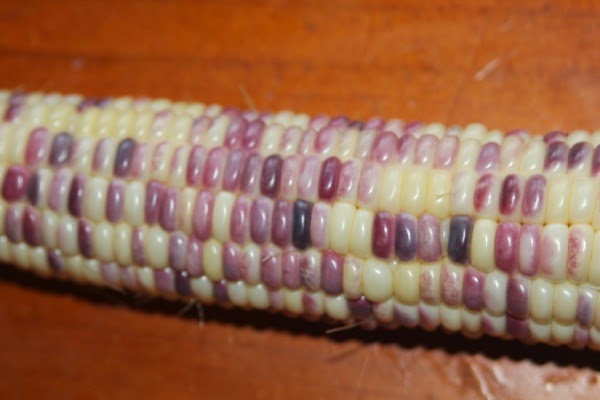
The early cobs lacked much colour, they tasted better than store bought corn but not as great as I had hoped.  Adding colour is not all that difficult, stabilising that colour is a bit more difficult, but I can do it.
Early Immali corn (ignore the yellow) - needs more colour
Tastes great, looks ok I guess, still a way to go

The later cobs look far better and taste far better too.  It is too bad I only get one crop of corn per year so progress is painfully slow.
Look how far it has come
Some fine looking "Immali corn" cobs
Still not there but look how far it had come

They still have a way to go, it is not yet stable and I do not want to distribute this seed until it is a bit more stable.  The colour will always vary a bit, but that is kind of the point.

The taste is a bit up and down right now, some cobs taste good while others taste simply amazing, all of them taste at least as good as store bought sweet corn.  This is mainly due to timing, if picked just right they blow me away, if picked too early or late they are not as good.  I would like to work out how to fix this, the genetics behind this are a bit beyond me at the moment as I do not have access to a good corn genetics book.  By only saving seed from the best tasting plants all of the Immali Corn should taste amazing by the time the colours are locked in properly.

Immali Corn
I worked hard to get here, we ate this cob and the colours remained unchanged through cooking

Once the strain starts to look more consistently like the cob above and is a bit more stable I hope to distribute seeds.  It may never be truly stable, it may be best if it always stays a landrace variety at least to some extent.  I hope that some dedicated seed saver somewhere will see the merits of Immali Corn and continue to grow it after I am gone.  Perhaps I should tell you what i hope to achieve in this variety.

So if I can get more of the cobs to look like the one above, and get the taste to be a bit more consistantly amazing, what else have I tried to include in this variety?

I wanted a reasonably small plant that was productive.  I figure people have less land these days so need small plants that are highly productive.  While 12 foot tall monster plants such as the Giant Inca White corn is spectacular to look at, it is not practical for Suburban Joe to grow in the corner of his yard.  The Immali Corn only grows about 5 foot tall.  It is not a dwarf plant, but it is not a giant either, I think it is a nice manageable compact size.

Immali Corn, reasonably short plants
I also wanted to create a variety that would be productive.  No point having a variety of corn that only produces 1 or 2 cobs per plant.  So far the Immali corn has produced an average of 4 cobs per plant.  I always plant corn too close and the weather is not always kind to corn, given better conditions and more space I think it could average a few more per plant.  Each stem produces 2 good sized cobs on average (some only 1, others 4), but then this variety is very prone to tillering (growing several stems).  This is probably a bad thing if you plan to harvest using a combine, but it is a great thing for home gardeners who harvest by hand.  It essentially means you get several times the corn from the same amount of space.  I am deliberately selecting for plants that produce more tillering as it is this trait that has helped raise the average number of cobs per plant.

Sideways corn picture, note the 2 cobs forming up high and 1 more lower down

 As well as a great tasting corn that is productive and takes up little space, I wanted something that was good to look at.  The cobs needed good colour, which was the primary reason behind this project.  One of the bonuses to using a coloured landrace as one of the initial stock was that the tassels sometimes are purple, it makes the plant look a bit more ornamental.

Immali Corn tassels and cobs
Immali Corn silk
Some of the cobs also display coloured silk.  I do not know if I will be able to keep this trait in this variety, but I will if I can.  It is one of the least important things I would like in the variety, but it does add something special to it.


Where can you get Immali Corn seeds?

Unfortunately for the time being you cant get Immali Corn anywhere, it is not yet stable and I do not want to release it now, stabilise it in a few years and then have confusion over which is the rubbish variety and which is the excellent variety when they both have the same name.  When I do release seeds they will probably be available through my For Sale page.

I think that you should breed some type of vegetable that you like.  Perhaps dont start with corn unless you are already experienced in breeding and saving seeds, perhaps start with a tomato or some beans or something simpler like that.  You dont need any fancy equipment, I certainly dont use anything special.  You dont need formal training in Botany or Horticulture or Genetics like I have, but you can still produce something amazing that can be treasured and passed on to others.

Read More..

Jumat, 13 Mei 2016

How to grow Babingtons Leek


Babingtons Leeks (Allium ampeloprasum var. babingtonii) are amazing little plants, I wrote another post on them and thought I should describe how to grow them.  They are edible and perennial and a bit more interesting than a regular leek.  Unfortunately they are on the brink of extinction in Australia and many other parts of the world.  I am selling small bulbils of Babingtons leeks in the hope that other people will grow and enjoy them and help them to become less rare.

Here are some notes on how to grow them, please note that I am no expert on Babingtons leeks, if something I say does not work feel free to try something else.  If you find some other way to grow them that works better please let me know and I will gladly pass this information on to anyone who wishes to grow them.

This is only a brief description of how to grow Babingtons leeks that has worked for me.  For information on how to grow any other perennial vegetables please go to my growing notes page.  To buy Babingtons leeks or other perennial vegetables, herbs, heirloom vegetable seeds, water kefir grains or milk kefir grains etc please go to my for sale page.

Babingtons Leek bulbs - should flower next year

Growing Babingtons Leek from from Bulbs
At this stage I do not have enough plants to sell mature bulbs but figured I would mention it for when your plants are larger or if I ever have enough to sell them too.  This is simple, plant the bulb a few cm deep and give it 15cm to 20cm or so from its nearest neighbour.  Plant it about the depth of the bulbs width, if it is too shallow it will drag itself deeper with the use of contractile roots.  Give it plenty of water, sunlight and mulch.  You should be able to harvest the leek by cutting it near the soil and have it re-sprout, if you get the timing right and the bulb was large enough it should still send up a flower stalk.  Each year if all goes well the underground bulb should divide into 2 or 3 mature bulbs for you and they may grow a few other smaller bulbs too

Babingtons Leek will die down to a bulb in summer, it may be possible to convince them to grow through but I have not tried that yet so can not comment.  If storing the bulbs be careful not to leave the bulbs out somewhere to dry out too much, also be careful not to leave them in soil that is too wet as they may rot.

Babingtons Leek plant almost ready to flower
 
Growing Babingtons Leek from Plants
If I have too many bulbils left over that sprout I plan to sell them as small plants.  Much like any other variety of leek, plant it reasonably deep to encourage a long white shank.  As above, plant 15cm to 20cm from its nearest neighbour, any closer than this will stunt the plant a little.  Plenty of sun, water and mulch will ensure the fastest growth rate.  During the first year they will be small and may not put on much growth above ground, this is normal.  They will mostly take 2 or 3 years until mature enough to flower.

Babingtons leek bulbils - note the small size

Growing Babingtons Leek from Bulbils
I mostly sell bulbils of the Babingtons leek, these are tiny leek bulbs that have formed on top of the flower stalk.  For this reason I will go into a little more detail in this section.

Each bulbil will most likely be genetically identical to the parent (although slight mutations may occur from time to time).  The bulbils are tiny, probably around the size of a pea but sometimes even smaller.  Bulbils are produced in early Summer but will not grow or do anything until Autumn or Winter.  They are ready when they fall from the flower stalk, I sell them when they are ready and will store and grow anything that is not sold.  If you buy bulbils as soon as they are ready you have two options: you can plant straight away or you can store them for later.  Each method has its merits and dangers, I will try to do a little of each to work out what is best.
Babingtons leek bulbils
Storing the bulbils gives you the peace of mind that they will not be eaten by anything or rot in the soil but runs the risk that they will dry out and die.  You also run the risk that they will not be in the soil when they are ready to grow or that they may not receive whatever signal they need in order to resume growth.  Some bulbils will look green, others will develop a brown outer skin.  I assume that the green ones will not cope with storage as well as the brown ones.  I also assume that the brown ones will be less likely to wake up when it is time to grow.

Planting the bulbils immediately runs the risk of rotting or being eaten by earwigs or whatever but also ensures that they will not dry too much and they are ready to grow when they need to grow.  I plant the bulbils a little under the soil surface or sometimes directly on top of the soil in the light.  I have heard that a grower overseas normally plants them 2 inches deep.  I urr on the side of caution, if they are not deep enough they will work it out or I could dig them and replant them when they are larger, if they are too deep they may not have enough energy to reach the sunlight.  It is best to plant them with the growing tip pointing up, quite often it is difficult to tell which way is up and in these instances it is best to plant them on their side.  Planted on their side they will work it out, planted upside down they may die.

No matter what you chose to do the bulbils will not do a great deal of anything until Autumn or even Winter/Spring.  Occasionally they may begin to grow in late Summer but only if the weather is cool.   Babingtons leeks are often rather small looking plants in their first year and the next season are far larger.  The bulbils will often take 2 to 3 years to be mature enough to flower, that being said if they are very happy they can flower in their first year.
Babbingtons leek, bulbils developing on the flower head


Growing Babingtons leeks is simple
While it sounds like a lot of work it isnt, most people who grow Babingtons leeks have a patch of them and pretty much ignore them other than to harvest them and to marvel at their amazing flower head.  Often overseas growers (I do not know any other Australian growers) tell me that Babingtons leeks thrive on neglect.  I figured I would go into a bit of detail so that you have the best chances of harvesting leeks as soon as possible.  I also want to make sure that if someone buys Babingtons leeks from me that they know what to expect and do not rip the plants out when they have not flowered in the first year from bulbils.  The pictures of the bulbils next to the measuring tape will help to ensure that if anyone buys bulbils from me that they know exactly what they are buying.

If you have any questions please feel free to ask, while I may not know the answer I will do my best to tell you what works and does not work for me.

Read More..

Sabtu, 07 Mei 2016

Skirret a forgotten perennial vegetable


I have never met a person who dislikes Skirret (Sium sisarum) and I dont expect this to change.  Very few people in Australia grow skirret or have even heard of this remarkable vegetable, but those that have tried it all seem to like it.
Skirret seedlings still with their juvenile leaves

What is skirret

Skirret is primarily an ancient root vegetable, but the leaves, stems and seeds are also edible and tasty enough in their own way.  This perennial root crop was grown and eaten across most of Europe for centuries prior to the Spanish conquest of South America.  After this time potatoes largely replaced skirret for a number of reasons.

Skirret is a perennial vegetable which, unlike many other perennial vegetables, also freely sets viable seed each year.  Most people who grow skirret reproduce it by breaking the plant into many smaller plants after harvest and replanting them.  Similar to yacon, the part you eat of skirret is different to the part you plant so you can increase the number of plants each year easily while still being able to enjoy the full harvest.

Seed grown skirret displays a lot of genetic diversity, I assume this is because no real breeding work has ever been done on it and it is mostly propagated by division rather than seeds.  Serious breeding of vegetables often results in highly inbred strains which contain all the desired traits but have little to no genetic diversity.  Sometimes this deliberate selection goes a little too far and the plants become highly susceptible to inbreeding depression (such as has happened to carrots and corn), other times it does not appear to bother the plants too much (such as tomatoes or beans).
The same skirret seedlings getting larger

What does skirret taste like

I am bad at trying to describe what things taste like and it has been a while since I last ate skirret but I will give it a go.  Skirret tastes kind of like carrot or parsnip or even a little like sweet potato or potato, but is sweeter than any of them.  That is probably not a great description as carrot and potato taste nothing alike.  Many people use skirret in the same dishes that potato, sweet potato, parsnip or carrot would be used.

Skirret also used to be used for deserts and the like, but I am not exactly sure how/what they do with it in these meals.  As mentioned earlier, most of Europe grew and ate skirret until the potato came along so it has a long history behind it as a food plant.

Skirret contains reasonably high levels of sugars and tastes rather sweet.  When the Germans were searching for alternative plants to sugar cane they reported that skirret ranked below the white sugar beet but above red beetroot.  Some of the common names for skirret translate into things like sweet root, water parsnip and sweet water root.  From these names you get the impression that skirret is sweet and likes to grow near water.
At this point I perhaps should have re-potted the plants separately

You can see the plant in the middle is already starting to divide

Problems with skirret and how to overcome them

Skirret can have thin roots, these can be a pain to prepare for a meal.  The roots are always long and there are always copious amounts of them, but if they are too fiddly to prepare no one will bother to grow or eat this remarkable plant.

Skirret can have woody cores to the roots.  Some people do not mind this, they cook the skirret and strip the roots with their teeth and discard the core.  I cant be bothered doing this and wont eat a vegetable which requires this kind of treatment.  First year plants grown from seed tend to have the woody core, as they age the core gets smaller or apparently even disappears in improved strains.  Lots of water seems to help prevent any woodyness at all.  Considering that this plant grows in marshes in the wild it makes sense that soil moisture would be beneficial.

Skirret loves cooler weather, I dont think it matters how cold it gets the skirret is never bothered.  It goes dormant over winter and is dug/harvested/divided during that time.  It does not love the heat.  As I currently live in an arid climate, lots of heat and very little water, growing skirret takes a bit of work.  Growing in part shade, or in a styrofoam box to help insulate the soil can help this plant to grow in less than ideal climates.  I have it growing in a pot which I can submerge in water on hot windy days.

Skirret is a plant that would benefit from some serious breeding work.  Pretty much every problem it has should be simple enough to overcome if someone puts the time and resources into breeding improved skirret varieties.  I honestly think if someone was serious about breeding skirret that it would only take 3 or 4 years to turn skirret from its current form into something truly remarkable.  If you ever do this breeding and grow improved varieties of skirret let me know as I would love to buy your plants or seeds.
Strong and healthy skirret

Everything looks good


Breeding potential of skirret

One of the great things about skirret is how happily it sets seed each year and it produces many seeds even if only one plant is growing.  Being in the Apiaceae family they produce copious amounts of seed if allowed, similar to a carrot, but in skirret the seed seems to display a lot of genetic diversity even if obtained from a single plant.

Most people who grow skirret do not grow from seed, instead they find a plant and do not let it flower so that all the energy is put into root development.  I think this is a mistake as it is not difficult to find a nice skirret plant, divide it and let one of the divisions go to seed so that you can continuously improve your stock.  Leaving a single plant in your patch to flower is not that great an imposition.  While letting several plants flower would be best, a single plant flowering and setting seed would still give a crop of diverse seedlings from which to cull and only keep the best ones.  The flowers attract a lot of beneficial insects so leaving a single plant in the back corner to flower is of benefit to the rest of your vegetables.

Skirret grows many edible roots which are nice and long, so there are no issues with root length or number, the problem comes from them being too thin and often having a woody core.  It should be possible to breed for superior varieties with fatter and less woody roots.  First year plants are more likely to have woody cores and plants that do not get enough moisture will also have a woody core so selecting for lack of fiber can be a bit tricky.  That being said, many people who have selected for improved plants overseas only do so for about 2 generations and then have plants that they are happy with.

I do wonder if skirret was grown using aquaponics or wicking bed if the woody core issue would be completely resolved due to constant access to water.  If this were to be the case then skirret breeding could focus on fatter roots, having one single focus should mean that improvements are made a lot faster as culling can be more harsh.

One of the issues we have in Australia is that so few people grow skirret that we probably have a bit of a genetic bottleneck.  Hopefully the natural genetic diversity on this plant will ensure that we can still select for improved varieties and make ground reasonably fast.  I would love someone to take on skirret and breed some improved varieties, if the woody core could be bred out of skirret there is no reason that people would not grow it in backyards or even for market gardens.  As mentioned earlier I have never heard of anyone who dislikes skirret, improved varieties could make this crop more common once again.  Skirret does not always cope with summer in my climate so does not always flower (or necessarily even survive) so I probably wont do a lot of serious breeding with it.  That being said each year my skirret does flower I will save and plant seed from the best plants and cull the weaker plants.
Skirret plants with adult leaves

Where to get skirret in Australia

People who know a lot about rare vegetables often tell me that skirret is not in Australia, and due to problems importing the seed that we will never be able to grow skirret.  I dont know how to respond to them as I have grown skirret before and I am also currently growing skirret.
Skirret plants in a small pot

If I divide my plants I will try to sell some crowns over winter on my for sale page.  I will also try to save seed from my best plants each year to sell on my for sale page but skirret doesnt like the heat and aridity of my climate so I can make no assurance that I will have seed or spare plants for sale.  This year my plants are growing very strong and have all divided into several plants, one even looks as though it may be about to send up flower stalk so everything is looking positive.

Failing that some Australian seed companies occasionally carry skirret seed in small amounts and I even know of a lady in Tasmania who sells skirret plants (as well as some other rare perennial vegetables) and will post them to the mainland.  While I have never bought from her we have conversed and I believe that she is honest, that being said I take no responsibility for her service or plants.

At some stage I will include some growing notes on skirret.  If you have never tried skirret I think you should get some and grow it. 

Read More..

Jumat, 29 April 2016

Best Heirloom Tomatoes part 1

This year I grew a few different types of heirloom tomato, I figured I would write a comparison between how they went in my garden.  There are a few that are not listed here as I kind of want to keep them under my hat for now, or they are not yet stable so their details are not going to be relevant just yet.  Most varieties listed are regular leaf and indeterminate, if anything was potato leaf or determinate I have written it in italics.  If any variety is what I consider to be a dwarf variety I have also included that in italics.
Heirloom tomatoes
Many seed sellers tell you the days to maturity, unfortunately what they mean is days from when the seedling is 30cm tall and transplanted into the ground to maturity.  They never tell you how long from sowing the seed until the first fruit.  I know of one variety that is often stated as 55 days to maturity from transplant but 120 days from seed.  Obviously a host of variables can change the days to maturity, but I would find it more useful to tell me from seed to the first ripe fruit which is why I have used those dates here.

Quite often seed catalogues write glowing reviews even for substandard tomatoes with poor taste and low yields, I have tried not to do that and if I dont like it or found something that could be better I have said so.  Some I wont save seeds from or grow again, others have merit so will get another chance or be used as breeding material to develop something better.
Tomato flowers from a productive variety

All seeds were sown the same day on 9 August 2014 without heat, all seedlings were transplanted into the vegetable garden about 7 weeks later when the majority were 15 to 20 cm tall (they were all planted out on the same day, some were larger than others).  I have included the date the first fruit ripened after the variety name.  They are listed in order that their first fruit ripened, sometimes there was a large delay from first fruit to any subsequent fruit, this has been noted.

______________________________________________________________________________


Reisetomate tomatoes
Reisetomate (25/12/2014) was overwintered and was the first tomato to ripen any fruit, this is not characteristic of the variety as the seed grown plant took about 2 months longer.  This was the only tomato I overwintered this year.  The deep red fruit are odd lobed shapes that can be pulled apart like the segments of an orange.  The taste is sour and intense and the tomatoes look interesting.  This plant produces a large yield, it has regular leaf and is semi determinate, it is my favourite red tomato.

Snow White tomatoes - usually more pale than the picture
Snow White (07/01/2015) was the first of the seedling plants to grow ripe fruit in my garden, it took about 5 months from sowing the seed to harvesting the first fruit.  Perhaps I will overwinter this and see how early I can get tomatoes next Summer.  The fruit is round and white if it does not get sun and slightly yellow if the sun hits the fruit.  The flesh tastes very sweet and fruity, the seeds/gel taste a little sour which compliments the sweet nicely, a real winner.  This is a great cherry tomato which was loved by everyone who tasted it.  This plant produces a very large yield over a long season, it has regular leaf and is indeterminate.

Juane Flamee, some small
Juane Flamee, some large
Juane Flamee (spelled various ways) (12/01/2015) was the second seed grown plant to produce ripe fruit.  It is said to be one of the best tasting tomatoes, I think it is certainly very good but not overly great, I think people love it because of the high yields it gives.  The fruit is round and orange, as can be seen by the pictures above the fruit size is rather inconsistent.  This plant produces a very large yield over a long season, it has regular leaf and is indeterminate.

Yellow pear, mostly brighter yellow than the picture
Yellow Pear (12/01/2015)  is a variety that I have been keeping for years, it grows nice looking yellow pear shaped tomatoes.  The plant grows huge and is a real survivor that has proven itself over many years of harsh conditions.  The sweet tomatoes are great for eating fresh or in salads and look beautiful.  This plant produces a massive yield (both in terms of number of tomatoes as well as overall weight of tomatoes) over a very long season, it has regular leaf and is indeterminate.

Black Russian, often cracks like this
Black Russian (29/01/2015) is one of the most over rated heirloom tomatoes ever grown, certainly not the best tasting black tomatoes I have ever eaten.  It still tastes much better than anything from a shop.  The fruit is prone to splitting and cracking but that does not matter much.  The plant produced a lot of flowers that simply aborted and produced no fruit even in good conditions with masses of pollinators.  It is said to be an early variety but took about 3 weeks longer than Snow White, Juane Flammee and Yellow Pear.  January 29 was the date of the first ripe tomato, it did not give a second tomato until 14 February which puts it behind Speckled Roman!  The colour of the fruit is amazing and they are a good size, unfortunately the taste, yield and time it takes to mature let it down.  This plant produced a small yield over a short and broken season, it has regular leaf and is indeterminate.


Tigrella, the colours are far more vivid than the picture
Tigrella (04/02/2015) is a great little tomato, it looked beautiful and tastes great.  The round stripey fruit had a dark seed cavity and were pretty consistent in size, most were a little larger than the picture.  The taste was a little stronger and more sour than Juane Flamee and it produced less tomatoes too.  The plant produced a reasonably large yield over a long season, it has regular leaf and is indeterminate.

Roprecco Paste, most were a bit larger than this
Roprecco Paste, a good tomato
Ropreco Paste (06/02/2015) is a good tomato, it looks much like a Roma tomato and tastes like a great Roma tomato.  The tomatoes are a good size and nice shape, most were slightly larger than pictured.  I liked to eat these fresh or in sandwiches, they can make a decent sauce, soup or paste due to their rich tomato taste.  This plant produced a reasonable yield over a short season, it has regular leaf and is determinate.

Malakhitovaya Shkatulka, delicious!
 Malakhitovaya Shkatulka (06/02/2015) is a great tomato which I cant believe is not grown more commonly in Australia.  The size and shape of the fruit lend it to slicing for sandwiches etc, the taste is absolutely amazing, probably the best tasting tomato ever grown.  Everyone who tasted this loved it.  It is difficult to tell when they are ripe from a distance, but simple enough when you are close enough to touch them.  I wish that it was higher yielding as they taste so great.  Birds leave the ripe fruit alone as it is green.  The name of this variety is kind of fun to say but difficult to spell.  This plant produced a medium to low yield over a long season, it has regular leaf and is indeterminate.

Julia Child, large pink soft fruit
Julia Child (08/02/2015) grows the softest tomatoes I have ever seen, the flesh is like soft butter.  It has very few seeds and a nice taste.  The pinky red round tomatoes are large and rather pretty.  They are perhaps too large as they hang on the plant for a long time ripening and may be attacked by insect pests etc during that time.  The plants itself looked lush and ornamental, it could grow by the front door and would not look out of place.  This plant produced a high yield over a long season, it has potato leaf and is indeterminate.

Unnamed red cherry
Unnamed cherry tomato (08/02/2015), these were given to me at a fete, I didnt want to grow an unknown variety but accepted them as I did not want to be rude.  I disliked them last year but figured I give them another go this year as a comparison.  The plant looks nice as do the trusses of 6 small perfect round red cherry tomatoes.  This plant is why I try to never grow unknown varieties of tomato unless they are someones family heirloom or something that someone has assured me is worth growing.  They tasted terrible (comparatively) and are low yielding.  I will not save seed from this horrible plant and will not grow them again.

Hillbilly - very glossy
Hillbilly
Hillbilly (12/02/2014) has firm flesh that is reasonably dry and smells great.  Tastes similar to a store bought tomato but much better, it smells fruity somehow.  The fruit is uniform in size and shape, good size for slicing onto a piece of bread.  The orange/yellow glossy fruit is interesting to look at but may cause people to turn up their nose as it is not red.  Probably not my favourite tomato this year but still pretty good, far better than most people have ever tasted.  This plant produced a medium yield over the season, it has regular leaf and is indeterminate.

Giant Siberian Pink
Giant Siberian Pink
Giant Siberian Pink (12/02/2014) these grew some large tomatoes!  Wow, look at those things.  They were pretty uniform in large size and most were very round.  I am not overly fond of large tomatoes as they hang on the plant so long to ripen and a lot can go wrong during that time.  They look suspiciously like Julia Child, I could not tell them apart by sight, but the texture could not be more different.  Firm flesh, it has a lot more seeds than Julia Child.  This plant produced a medium to large yield (medium number of fruit, super large size) over the season, it has regular leaf and is indeterminate.


Unnamed Red Stuffer
Unnamed Red Stuffer
Unnamed Red Stuffer (12/02/2014) red round medium sized fruit that is hollow.  The seeds stick together in a tight clump in the middle and are simple to remove making this a good stuffing tomato.  They tasted much like a store bought tomato before they were completely ripe, their taste intensified a lot after they ripened properly.  Even though this is a stuffing tomato it still went well on a sandwich.  I dont think this variety is stable yet.  This plant produced a medium yield over the season, it has regular leaf and is indeterminate.

Yellow
Yellow (12/02/2014) beautiful medium to large yellow fruit sometimes with green shoulders.  The plant was one of the first to flower but the fruit took a long time to ripen which is a negative as the fruit hangs so long.  The flesh was soft and moist, they taste pretty amazing and are low acid.  This is one of the most useful and best tasting tomatoes that I grew this year.  I think this variety is stable now.  I really like this variety for a number of reasons.  The fruit splits a little but that doesnt seem to affect the storage time.  This plant produced a medium to large yield over the season, it has regular leaf and is indeterminate.

Speckled Roman, more beautiful in real life
Speckled Roman
Speckled Roman (13/02/2015) stunningly beautiful looking red roma style tomatoes with yellow/orange stripes.  Each tomato has unique swirls, stripes and patterns inside the fruit with very few seeds.  It has a deep rich tomato taste, it is meant to make a great paste or sauce and I love it on a sandwich, much like a great tasting roma tomato that looks amazing.  I prefer this to Roprecco Paste as it tastes better, looks better, has larger fruit, and is indeterminate.  Roprecco paste seems to have a higher yield than this one but this provides fruit over a longer season instead of all at once so ther is a trade off to be made.  This plant produced a decent yield over the season, it has regular leaf and is indeterminate.

Pineapple some had much more red
Pineapple tomato
Pineapple (17/02/2015) not quite round, yellow orange (to red) bicolour that looked nice.  Some fruit were as large as the Giant Siberian Pink, others much smaller.  The inside of the fruit was also pretty with swirls of colour through the yellow.  Some tomatoes had a thick core that had to be removed before eating, others from the same plant did not.  Flesh was very firm, dry and contained few seeds.  This plant produced a good yield over the season, it has regular leaf and is indeterminate.

Reisetomate - not quite ripe
Reisetomate fruit
Reisetomate, every fruit is unique and beautiful
Reisetomate (19/02/2015) first fruit from seed grown plants ripened about 2 months after the overwintered plant.  Fruit ranges in size/shape/number of lobes quite a bit.  I love this tomato, it tastes so intense, even a little on a sandwich with a more bland tomato livens things up a lot.  The deep red fruit has odd lobed shapes that can be pulled apart like the segments of an orange, the flowers and fruit look very unique and interesting.  This plant produces a large yield, it has regular leaf and is semi determinate.

This post is getting a bit long, I have been writing it since December though.  I will end here and continue this post in Best Heirloom Tomatoes 2014-2015 part 2

I may sell some of these seeds, if you are interested please look on my For Sale page.
Read More..