Tampilkan postingan dengan label immali. Tampilkan semua postingan

Sabtu, 14 Mei 2016

Immali corn


I started messing around with corn breeding a few years ago. Corn genetics is messy, the more I learn the more I find that I dont know.  Genetics was so much easier when we knew nothing!

Many varieties of corn suffer from varying amounts of inbreeding depression, to save seed it is best to grow at least 200 plants and save seed from the best 50 to 100.  Some varieties of landrace corn have little to no inbreeding depression, but the down side is that they can be rather variable.  Using landraces as breeding stock means that genetic bottlenecks are not as tight and small populations can be slightly more forgiving.

Corn will happily cross pollinate with other types of corn that are within a few hundred metres up to a few kilometers of each other.  This makes saving corn seed difficult unless you live on acreage and have no one growing corn near you.

As I currently live on acreage and have no one growing corn close to me I save seed from a few different types of corn.  If I get the timing right, and am vigilant with selecting seed and rogueing out off types I could probably grow half a dozen types of corn each year without too much trouble.

I grow some interesting coloured corn, most of which is popcorn or dry corn as there are very few coloured sweet corn varieties available in Australia.  I once looked online at the amazing coloured sweet corn that is available overseas and asked myself: "self, why doesnt someone in Australia breed a decent coloured sweet corn?"  I looked around for someone who was developing a decent coloured sweetcorn in Australia, I could not find them.  I did find some people who are maintaining a few coloured sweet corns and a few who are developing the most wonderful yellow or white sweet corn, but none of this is what I was after.

So I decided to try to breed one myself.
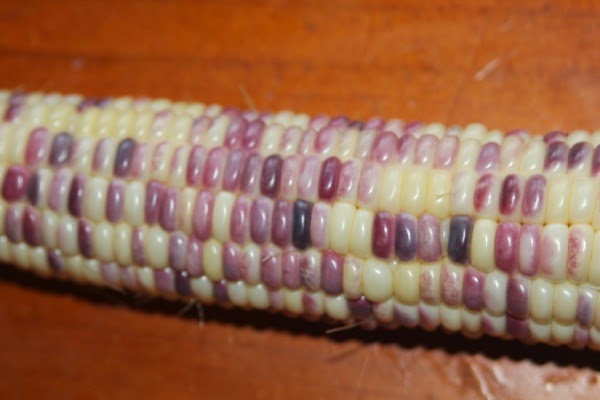
Coloured Sweet Corn
Immali Corn 2015
I have some access to different coloured field corn and some different varieties of sweet corn that the average grower would not have seen.  I researched the varieties that I have access to in order to determine the best parental stock for my new variety of corn.  I got a landrace coloured sweetcorn, which tasted ok and has a lot of genetic variation.  This was one of the parents of Immali corn.  Every generation since then has been remarkably better tasting.

Some "Immali corn" seedlings
I planted some of the coloured seeds and saved quite a lot.  The results were good, but being so early it is clearly not stable and had a way to go.  A little back crossing would help to lock in the desired colours and also maintain a high level of genetic variation.

The early cobs lacked much colour, they tasted better than store bought corn but not as great as I had hoped.  Adding colour is not all that difficult, stabilising that colour is a bit more difficult, but I can do it.
Early Immali corn (ignore the yellow) - needs more colour
Tastes great, looks ok I guess, still a way to go

The later cobs look far better and taste far better too.  It is too bad I only get one crop of corn per year so progress is painfully slow.
Look how far it has come
Some fine looking "Immali corn" cobs
Still not there but look how far it had come

They still have a way to go, it is not yet stable and I do not want to distribute this seed until it is a bit more stable.  The colour will always vary a bit, but that is kind of the point.

The taste is a bit up and down right now, some cobs taste good while others taste simply amazing, all of them taste at least as good as store bought sweet corn.  This is mainly due to timing, if picked just right they blow me away, if picked too early or late they are not as good.  I would like to work out how to fix this, the genetics behind this are a bit beyond me at the moment as I do not have access to a good corn genetics book.  By only saving seed from the best tasting plants all of the Immali Corn should taste amazing by the time the colours are locked in properly.

Immali Corn
I worked hard to get here, we ate this cob and the colours remained unchanged through cooking

Once the strain starts to look more consistently like the cob above and is a bit more stable I hope to distribute seeds.  It may never be truly stable, it may be best if it always stays a landrace variety at least to some extent.  I hope that some dedicated seed saver somewhere will see the merits of Immali Corn and continue to grow it after I am gone.  Perhaps I should tell you what i hope to achieve in this variety.

So if I can get more of the cobs to look like the one above, and get the taste to be a bit more consistantly amazing, what else have I tried to include in this variety?

I wanted a reasonably small plant that was productive.  I figure people have less land these days so need small plants that are highly productive.  While 12 foot tall monster plants such as the Giant Inca White corn is spectacular to look at, it is not practical for Suburban Joe to grow in the corner of his yard.  The Immali Corn only grows about 5 foot tall.  It is not a dwarf plant, but it is not a giant either, I think it is a nice manageable compact size.

Immali Corn, reasonably short plants
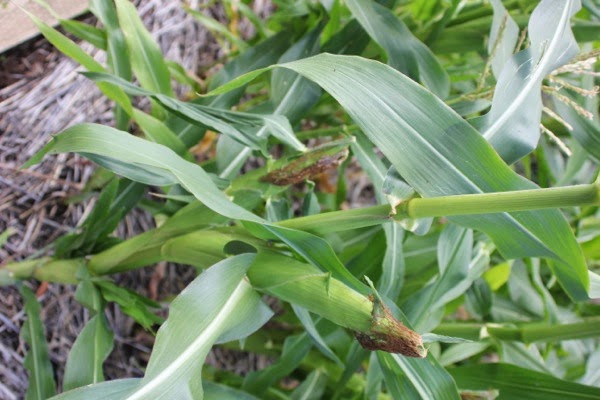
I also wanted to create a variety that would be productive.  No point having a variety of corn that only produces 1 or 2 cobs per plant.  So far the Immali corn has produced an average of 4 cobs per plant.  I always plant corn too close and the weather is not always kind to corn, given better conditions and more space I think it could average a few more per plant.  Each stem produces 2 good sized cobs on average (some only 1, others 4), but then this variety is very prone to tillering (growing several stems).  This is probably a bad thing if you plan to harvest using a combine, but it is a great thing for home gardeners who harvest by hand.  It essentially means you get several times the corn from the same amount of space.  I am deliberately selecting for plants that produce more tillering as it is this trait that has helped raise the average number of cobs per plant.

Sideways corn picture, note the 2 cobs forming up high and 1 more lower down

 As well as a great tasting corn that is productive and takes up little space, I wanted something that was good to look at.  The cobs needed good colour, which was the primary reason behind this project.  One of the bonuses to using a coloured landrace as one of the initial stock was that the tassels sometimes are purple, it makes the plant look a bit more ornamental.

Immali Corn tassels and cobs
Immali Corn silk
Some of the cobs also display coloured silk.  I do not know if I will be able to keep this trait in this variety, but I will if I can.  It is one of the least important things I would like in the variety, but it does add something special to it.


Where can you get Immali Corn seeds?

Unfortunately for the time being you cant get Immali Corn anywhere, it is not yet stable and I do not want to release it now, stabilise it in a few years and then have confusion over which is the rubbish variety and which is the excellent variety when they both have the same name.  When I do release seeds they will probably be available through my For Sale page.

I think that you should breed some type of vegetable that you like.  Perhaps dont start with corn unless you are already experienced in breeding and saving seeds, perhaps start with a tomato or some beans or something simpler like that.  You dont need any fancy equipment, I certainly dont use anything special.  You dont need formal training in Botany or Horticulture or Genetics like I have, but you can still produce something amazing that can be treasured and passed on to others.

Read More..

Senin, 11 April 2016

Snow White heirloom tomatoes


This year I am growing a bunch of different varieties of mostly heirloom tomatoes, some are incredibly difficult to find while others are far more common.  I will try to write a post comparing them all later in the season once they have all ripened or decided not to ever ripen.  For now I want to tell you about one of the best tasting cherry tomatoes I am growing which is called Snow White.

Cherry tomatoes are good, but many lack any real taste, they are often good for kids who like sweet things.  White tomatoes are good, but many tend to be a little insipid, that being said there are some amazing white tomatoes around.

I had heard that Snow White was one of the best tasting tomatoes ever bred and one of the best cherry tomatoes around, this had me intrigued.  I have also heard from others that it is nothing special and I would be better off growing other varieties.  A very generous grower sent me some seeds last year, how could I resist growing this and seeing for myself.
Snow White cherry tomatoes

The plant grew well in my garden while a few other varieties did not even survive, it flowered early and was one of the first tomatoes to ripen in my garden.  It seems to have a lot of flowers and unripe fruit on the plants at all times, being an indeterminate variety it should continue to fruit right up until frosts. 

The plants themselves are nothing remarkable, they grow about 6 feet tall here like many other varieties but I assume that they could grow a lot larger.  They have regular leaf and everything looks normal enough.  It would be nice if they were a dwarf plant or if they had potato leaf or something, but in the end none of that really matters.  The plants grow well under adverse conditions, provide large yields, but it is the taste that truly matters.

The first tomatoes I picked may not have been properly ripe, the seeds in them were not properly formed so it may not have been pollinated properly, or perhaps they get better as the season progresses, all I know for sure is that the first few were not indicative of this variety.  When I tasted them they were ok, nothing special, it is probably fair to say that the taste was a bit confused.  Considering that they were bred by Joe Bratka who is an excellent tomato breeder that has been described by those who know him as confused or eccentric I was not overly surprised.  The flesh was sweet and tasted a bit fruity, almost like a bland peach.  The seed part tasted like a regular cherry tomato, good but not great.  Overall it was good but nothing special, if the rest of the tomatoes tasted like this I may not want to grow this variety again.  The tomatoes ripen to a very pale yellow if they are in the sun or white if they do not get any sun on the fruit. 
Snow White tomatoes - yellow in the sunlight
Visually they looked good enough, they produced a lot of tomatoes, but due to the fact that there are thousands of varieties of tomato available in Australia I do not want to waste time or space if the taste does not blow me away.  I would rather keep trying to find something amazing. 

Then there was a week with no new ripe tomatoes, I was ok with that as they were not that great and the weather was odd.

Then the plant started to ripen again so I ate another tomato.  WOW.  They really blew me away.

Perhaps the first fruit were not great but since then they have been fantastic.  The tomatoes look much the same as the first ones, perhaps slightly larger, but the taste is amazing.  The flesh part tasted like delicious fruit, perhaps a peach or sweet ground cherry or something similar to that.  If I was to remove the seeds and blind test people I doubt that they would even recognise this as a tomato.  The seed part tasted like a good cherry tomato, a little acid but not too much.  The two parts together compliment each other well.  I love this tomato, I want more of them, I walk past the plant a few times each day in the hope that another one has ripened. 
Snow White hidden in the back of this part of the garden
The kids love this tomato, in my mind this is one of the best sweet tomatoes that I have eaten.  They are low acid so good for people who normally can not eat tomato.  I probably wouldnt use it to make paste or sauce or for cooking (although many people claim they are great for this) but happily eat them fresh or in salads.  They are remarkable.

I would almost go as far as to say that they are unique, but they are not.  Apparently the man who bred these also bred a few others which were much the same or exactly the same or just renamed this variety.  It doesnt matter too much, what does matter is that these are amazing and I plan to grow them again and hopefully grow a few more plants so I get more of them. 


Why are these tomatoes rare?

I have often wondered why this kind of thing is not more common, if they are so great (and these tomatoes do taste great) why are they not available at the supermarkets.  People often talk about home tomatoes being better because they are picked perfectly ripe instead of mostly green, or that they are fresh, or that they are too soft to be transported, and a few other things like this.

I am sure this is part of the answer, but I think one of the biggest problems is marketing.  People think of tomatoes as red, they are wary of any other colour.  Bright yellow tomatoes have started to become better known and appreciated in salads for their attractive colour.  Some of the brown/black ones have started to come in, but they have backing from a multinational company who holds a lot of power.

These are white tomatoes, they mostly ripen a pale yellow.  Many people think pale colour means tasteless or not fully ripe.  The difference between white tomatoes and yellow tomatoes is that the white ones have translucent skin.

Some people have asked me if yellow tomatoes taste the same as normal tomatoes.  I dont know how to answer them.  Where do I even begin?

Unfortunately this means that the average person will never try these amazing little tomatoes unless they grow them at home as they will not be seen in supermarkets anytime soon.  Some of the best tasting varieties of tomatoes ripen green, many people will not even try them, that is their loss.


Where to get Snow White tomatoes

Seeds of snow white tomatoes are reasonably simple to find in Australia.  Snow white tomato seed seems to be carried by a few different sellers as well as ebay.  I have saved seed from my plants and will most likely sell some on my for sale page with other heirloom vegetables and perennial vegetables.

Read More..

Jumat, 08 April 2016

Perennial Tomatoes

Everyone loves tomatoes, they are often grown as annuals and may people complain that they wish there were perennial tomatoes.  Well, there are perennial tomatoes.  I have seen seeds of perennial tomatoes for sale on ebay fetching serious money and I ask myself why.  Perhaps it is because people do not know about how to grow perennial tomatoes.  They are far more common than you think.
perennial tomato
Indeterminate tomatoes can be grown as perennial tomatoes
Different types of tomato
There are many thousand different types of tomato, I am not exaggerating here, probably about ten thousand recognised varieties world wide with a lot more being developed (by home growers such as myself as well as Government breeding programs) each year and a lot becoming extinct each year.  In the supermarkets we probably have access to half a dozen or so, by growing heirlooms we have easy access to several hundred varieties of all kinds of shapes/sizes/colours.  By growing heirlooms it is simple to save seed of the best varieties each year.  Of the many varieties of tomato that we have the easiest access to they can be roughly divided into two groups: determinate and indeterminate.


Roprecco Paste, a good determinate variety
Determinate tomatoes fruit pretty much all at once, then they tend to die, they are most easily grown as annuals.  They produce flowers at their terminal bud, after they flower that branch can not produce more leaves and stems.  These are great if you want all of your crop to harvest once, they are great for large scale farmers who only want to harvest once, as well as people who are into home preserving.  If you are planning on making paste or sauce then you probably want a determinate variety, there are several incredibly old and delicious heirloom varieties that are determinate.  I dont grow many of these, but I do grow a few, they serve their purpose well.  Some places claim determinate tomatoes are short and do not require staking, this is not always the case, please ignore anyone who makes such claims and stop buying seeds from them.


Speckled Roman, a good indeterminate variety
Indeterminate tomatoes can fruit over a long period, they keep growing as long as you protect the plant, they can be grown as perennial tomatoes if grown without frost.  They grow flowers from a side bud, not the terminal bud.  These are great if you want a few tomatoes each day or every few days, for many weeks/months on end.  Most varieties of tomato grown at home tend to be indeterminate, most heirlooms tend to be indeterminate (but there are some determinate ones too).  Some of these plants can grow massive while others can be rather compact.  Even though indeterminate tomatoes are perennial tomatoes they still tend to be grown as annuals.  Almost all indeterminate tomatoes are perennial tomatoes, no need to spend ridiculous amounts of money on "perennial tomato" seeds now.  Some places claim that indeterminate tomatoes are tall and require staking, this is not always the case, please ignore anyone who makes such claims and stop buying seeds from them.


Perennial Tomatoes

Many varieties of indeterminate tomato are a short lived perennial if grown in a warm climate, which is great if you happen to live in a warm climate.  Sometimes they can survive for several years but the productivity often drops off after the first year.  I live in a frosty climate and have often wanted to grow the same tomato year after year, not just save seed, but keep the same plant going.  Even if you live in a frosty climate it is possible to over winter plants.  They probably wont produce a lot of fruit over winter, they will continue to flower but often the nights are too cool for fruit set, as soon as the weather is warm enough they will be ready and will ripen some early fruit for you.  This is a great way to get your plants to set fruit a few weeks to a few months earlier than from seed.
Overwintered Reisetomate set fruit 2 months earlier than the seed grown Reisetomate
Each year I overwinter some tomato plants.  Sometimes I do it because I am running low on seed, sometimes I do it because the plant was amazing and I want another season out of it, sometimes I do it because I am developing a new variety and would like to back cross its progeny with it to lock in a certain desirable trait.  Plants that are overwintered tend to crop a lot earlier and be more resilient than seedlings of the same variety.  Sometimes I overwinter a plant to help get an early crop and beat the extreme weather that we often get.
Yellow Pear tomatoes are simple to grow as perennials


How to overwinter an indeterminate tomato

This is one of those things that depends on a lot of different factors, mostly it depends on what you want to do and in which climate you are growing tomatoes.  You may wish to put up a shade cloth structure or something to protect a plant growing in the soil.  You may grow a plant in a pot that can be moved to somewhere safe.  You may live somewhere that the plants can be left as they are or just mulched carefully.  I take cuttings and overwinter these.

I take a cutting late in the season from the plant that I want to overwinter.  I use indeterminate varieties, while it is possible to use a determinate variety it is far more difficult as timing has to be just right and sometimes cuttings have to be taken throughout winter to prevent flowering.  Remember, if a determinate tomato flowers it will not grow any more or be able to produce new leaves or new sets of flowers.

The cutting will be genetically identical to the original plant, it is essentially the same plant.  I remove any flowers, remove the lower leaf or few leaves as they do not cope under water, then put the cutting into a glass of water.  The part I cut needs to be under water, the leaves need to be above the water, very simple.  You could plant the cutting directly into soil at this point instead of using water but I like to see the roots first so I use a glass of water.
Tomato cuttings
Tomato cutting, ready to plant into soil
Normally in 3 days small roots appear, it may take a lot longer in cooler weather, it may be as fast as 8 hours in the right conditions.  The roots grow fast once they have started so I try to plant it into a pot of soil quickly.  Water roots are different from soil roots, so it is best to plant it after the roots are only short rather than wait a few extra days until they are long (like the picture below).  I then put this potted cutting somewhere safe over winter.

During this time it will grow and it should flower, mostly the flowers abort as the night temperatures are too low.  I grow them outside under the verandah against the mud brick where they get sun and warmth but no frost, if you live somewhere colder you could grow them inside near a window for light.  They need sunlight or they will become sick and attacked by insects.
Perennial tomato plants
This is the same cutting on the left, the second cutting was put in the water when the first picture was taken
After the frost has passed I often have a strong 3 foot tall flowering tomato plant ready to be planted out in the garden (or left in the pot and moved into the sun).  Quite often seed grown plants will only be 10cm tall at this time so the overwintered plant gets a significant head start.

This process of taking cuttings to overwinter can be continued indefinitely, each time you take a cutting you are restarting the clock and the plant will not die of old age.  If you have found a good F1 hybrid that you like and can not save seed from you do not need to buy new plants each year as you can simply take a cutting and overwinter the same plant.  You no longer need to waste money on perennial tomato seeds, just look for a good indeterminate variety as they are perennial.

Far too easy, you now have perennial tomato plants even if you live in a frosty climate.  I sell some heirloom tomato seeds on my for sale page.  Many of these are indeterminate and can easily be over wintered, if you are interested please have a look.

Read More..