Tampilkan postingan dengan label most. Tampilkan semua postingan

Selasa, 26 April 2016

Pineapple Sage one of the most delicious and useful herbs


I first heard about Pineapple Sage (Salvia elegans) on the internet somewhere and I was both intrigued and skeptical.  Everyone who wrote about growing or eating this plant raved about how great it is.  I wanted to try some but did not want to pay a fortune for one through some mail order and then find it did not smell like pineapple, or that it smelled of pineapple but the pineapple smell was overpowered by the smell of sage.  I was lucky enough to find a small plant for sale in a shop somewhere and was able to smell it before buying it.  It smelled delicious, just like sweet pineapple.  After smelling it I had to buy one and try and grow it.  I am happy to say that it was simple to grow and performed rather well even in my harsh climate.
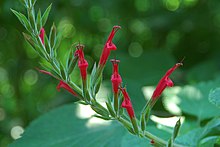
Pineapple sage flowers are sweet and delicious, just like the leaves

Pineapple Sage is quite possibly my favourite herb.  Many herbs are meant to smell like something, and they do if you use your imagination and wish really hard, but pineapple sage is different.  Other things smell different depending on where or how they are grown, how much water they are given or even the time of day that you smell them, chocolate mint is a prime example of this.  Other herbs have faint scents, or they have the scent of its name sake but it has another smell that overpowers it.  Pineapple sage actually smells like pineapple.  It really does.  It is not a faint pineapple smell that also has a sage smell overpowering it, it smells strongly of pineapple and nothing else.

Pineapple sage, like many of the vegetables that are eaten in Australia, is native to Central and South America.  It is less hardy than regular sage, frost knocks it around a bit if not protected, and it needs a little more water than regular sage, but it is still worth growing.  I grow some in the garden, mulch it well and hope that when the tops get burned off by frost that the roots will survive and re-sprout in Spring.  As well as growing it in the garden I always have one or two in pots, that way if we do happen to get an especially hard frost that kills off the garden grown plants I still have one in a pot to start over with when the weather warms up again.  It is simple to propagate via cuttings, but they only seem to take for me during the cooler weather.

I love pineapple sage, after reading about it on the internet it seems that I am not alone in my love for this plant.  I would grow it simply to smell as I walk and brush past it.  Water is scarce out here so I would struggle trying to justify growing a plant that simply smells nice.  Luckily it is not just a nice smelling ornamental, the whole plant is edible and useful in a number of ways.

Both the leaves and flowers of this versatile plant are edible, the leaves are used to flavour meat, poultry and other main meals, it is used in herbal tea, used for sorbets as well as a large range of desserts.  The flowers can be added to drinks, jellies, jams, desserts and fruit salad.  My kids and I like to make tea by steeping the leaves in hot water and adding some honey or sugar.  Even my eldest son Igloo, who is rather picky about drinking such things loves the smell and the taste of pineapple sage tea.  Igloo is trying to convince me to let him grow 100 pineapple sage plants in his little vegetable garden, perhaps we will start with one and see how he goes.

Pineapple sage is meant to deter some pest insects, so I grow a few in amongst the vegetables in the garden.  To be honest I do not know if it makes any real difference, but nothing seems to grow any worse by having pineapple sage next to it and it is good to have a few extra plants.  By hiding it in amongst the vegetables they seem to be slightly safer from children who love to steal the leaves to eat them or do whatever it is that kids do with nice smelling leaves.
Pineapple sage grows well in a pot or in the ground


Pineapple sage leaves are a nice shade of green, in Autumn to Winter it will flower with beautiful red flowers.  These flowers smell as delicious as the leaves and are often visited by honey bees and several other pollinators.  We have seen honey bees as well as nine different species of native bees on the pineapple sage flowers, they simple adore it.  By flowering in Autumn and Winter they provide food for pollinators and beneficial insects in a time when traditionally they do not have a lot of food available in this area.  If you can grow it in a protected spot where the frosts will not burn it you will have it flowering most of the way through winter.  This means that come Spring you have a large number of pollinators and predatory insects already living in the garden ready to pollinate flowers and take care of any insect pests that may be around.

According to the internet pineapple sage is extensively used in Mexican traditional medicine, especially for the treatment of anxiety, depression, stomach aches, evening out blood sugar and for lowering of blood pressure.  I cant comment on how effective it is, but Igloo does seem a lot calmer and happier after he has drank some pineapple sage tea.

I have seen a golden leaf form of pineapple sage, apparently it is the same as regular pineapple sage but looks a bit prettier.  Some day I hope to track it down and try to grow it as well, but for now I am happy with the regular pineapple sage.

If you have never grown pineapple sage you should try it. Your kids will thank you for it.


Read More..

Sabtu, 23 April 2016

Comparing Perennial Leeks with Regular Leeks


Perennial Leeks

Perennial leeks are rare and difficult to find in Australia for some reason, yet they are simple to grow and one of the best and most productive vegetables to grow for home gardeners.  I would hate to be without them again, if we ever lost them in a bushfire or something I would be devastated.  I have had a lot of questions about the perennial leeks from different people, so thought it best that I write another post and answer some of them.

Perennial leeks Australia
Perennial leeks - note the baby leeks growing from their bases

 What are they, how to grow perennial leeks?

I have some growing notes here.  I will tell you a few things now that were not covered in my growing notes page.

Perennial leeks are an amazing plant, they are hardy, productive and delicious.  People often ask when to plant perennial leeks, we plant and divide perennial leeks all year.  When we harvest a leek for dinner I then plant the small baby leeks that are growing from the large ones base.  It is only over the hotter summers when the plants are dormant that we do not harvest leeks, even then I occasionally dig up the bulbs and plant them out in other places.  Even when we lived near Canberra we could divide and plant them all year, the frost and the heat does not seem to be too much of an issue with them.

Summers here are extremely hot and dry and the leeks tend to die down to bulbs, in cooler climates or even cooler years they grow all year.  They flower here but generally nothing comes of it.  One year after floods we had them set viable seed which I think was a cross between the leeks and elephant garlic, that year the flower heads also grew small leek bulbs in the same way that tree onions grow small onions on the flower stalk.  These things have only happened that once and I have not been able to convince them to flower since.

Some people ask me how they compare with other types of leek.  When I wrote my first perennial leek post I had never grown or eaten any other varieties of leek to be able to compare, since then I have grown and eaten some regular leeks so can compare them.  I considered buying some leek seeds to grow, but I have grown onion seed and find them fiddly so did not want to do that if I did not have to.  The leeks in the supermarket were so much larger, both longer and fatter than the perennial leeks, so we bought some for dinner a few times just to see if they were any better.  After cutting off the roots with a few mm of shank I put them in a jar with a little water and they sprouted.  We used to do that with the perennial leeks to build up numbers the first year that we had them so figured it should work with any leek.  It worked fine and the regular leeks grew well.  I then grew the two types of leek, perennial and store bought, in adjacent beds to see how they compared. 
perennial leek plants
Perennial leeks - I need to take a few more pictures for this post

Comparing Perennial Leeks with Regular Leeks

Below is roughly how they fared compared with each other.  Please try to keep in mind I only grew them over one year, I had an unknown commercial supermarket strain (or several unknown strains), and had small numbers of store bought leeks so this comparison is far from scientific:

The store bought leeks taste pretty much the same as the perennial leeks, no noticeable difference there.  Some people who I have sold perennial leeks to have claimed that the perennial leeks are sweeter or tastier, but I am not convinced that I could tell any difference.  Both types of leek cooked the same, neither one was tough or bitter or anything like that.

While the store bought leeks were larger, the perennial leeks grew faster and sent up a lot of babies and we ended up with a greater harvest of perennial leeks compared to store bought leeks on the same area of land.  So from a yield per area of garden the perennial leeks came out on top by a long way.  When harvesting perennial leeks there are always baby leeks that you can use as replacements, which maximises the use of space.

The perennial leeks reproduce slowly throughout the year, then around November they explode in numbers.  From one well grown plant I ended up with 128 leeks in 12 months.  During this time I would have been able to eat leeks as well as increase their number had I wished.  The store bought leeks did not flower in the 12 months, but I assume had I left them in for another 6 months or so they would have flowered and produced hundreds if not thousands of seeds.  I guess there is a trade off here, the store bought leeks would have reproduced more than the perennial leeks if they had more time, but we would not have eaten leek during that long time.  The time it would take to go from a seed to an edible leek is also a lot longer than to go from a baby perennial leek to an edible sized leek.

When saving leek seed it is advisable to grow out at a minimum of 80 plants to prevent problems with inbreeding depression, you would then rouge out any plants with undesirable characteristics (minimum numbers based on info from http://www.seedalliance.org/uploads/publications/Seed_Saving_Guide.pdf).  That is a lot of space to tie up each year just to produce leek seed for the following season.  Leek seed is only viable for a year or two, so you would end up having to tie up that much space all the time just to produce leek seed, you would then have to allocate another bed to produce leeks to eat.  Of course you could just buy leek seed each year, but then you may as well just buy leek from the supermarket to eat and use your vegetable plot for growing something else.  When growing perennial leeks you can grow a single plant if you wanted to and build up numbers from that, there will be no inbreeding, and rouging out is not needed as every baby it produces will be genetically identical to the parent (this is not exactly true as sometimes mutations pop up, but that is an in-depth topic that is best not covered here).  There is also no problem with perennial leek about having to isolate plants to prevent them crossing with the neighbours leeks which can be an issue if you live in town.  So from a sustainability point of view the perennial leeks end up as the better option.

Regular leeks can be grown as perennials, harvested close to the ground and allowed to regrow.  Perennial leeks are superior here as they can be grown and harvested the same way but continually reproduce and allow you to build up numbers if you wish.

Regular leeks are a bit larger, but the ones I grew were nowhere near as large as they originally were in the store, perennial leeks are a bit smaller.  I assume that if I grew the perennial leeks better they would be a bit larger, but I also think that regular leeks will always be a bit larger than perennial leeks.  If you do not divide them, the perennial leeks end up as a clump of hundreds of plants that are as thin as chives.  This can be a down side of perennial leeks, it can also be easily avoided by dividing some of them occasionally.

One of the store bought leeks grew with a red stem and looked nice, the perennial leeks were just green.  Occasionally a variegated perennial leek turns up, but other than that they are just green.  I like the look of the variegated perennial leeks myself but they only seem to turn up occasionally.  At the end of the day these are a food plant, looks are secondary.

To the best of my knowledge there is only one or two varieties of perennial leek in Australia whereas there are a whole lot more varieties of seed grown leek.  Some types of seed grown leeks are suited to warm climates and others are suited to cool climates.  Some grow long and thin whereas others grow short and fat, apparently each of these types is better suited to different climates.  I have sent perennial leeks to a few parts of the country and so far am yet to find a climate in which they are not productive.  This lack of choice with varieties is not an issue as I am happy with these perennial leeks, if they were not fantastic then this lack of choice would matter a whole lot more.

From what I have been told perennial leek will cross pollinate with any variety of regular leek and they say that the offspring are less desirable than either parent, so if you grow both it is best to remove the flower stalk from the perennial leek to prevent problems.  I have never let regular leeks flower so can not say too much about the subject.  Perhaps if you were to let a regular leek flower next to a flowering perennial leek you could grow the resultant seed and perhaps get a new type of perennial leek!
Perennial leek bulbs - they only die down to bulbs some years if it is too hot or dry


My conclusion

Over all the perennial leeks were a lot easier to grow, they were producers of food throughout the year, they were producers of huge amounts of food for a small area, and I know that if I forget about them for a year (or ten) that they will still be there waiting for me.

After growing the two types of leeks and comparing them I dont think I can be bothered growing regular leeks again and will stick with the perennial leeks.  I understand that there are many varieties of regular leeks and someone should preserve them and prevent them from going extinct, but that someone should not be me at this point in time.  I am happy with perennial leeks and at this stage want to spend my energy saving seed of other things.

I do have perennial leeks for sale as well as some seeds, herbs and other perennial vegetables on my For Sale page.  I am not keen on posting outside of Australia unless you have already contacted your countrys quarantine and are confident that they will be allowed through.  That being said I am happy to try my best to answer any questions about perennial leeks from people even if they are overseas.

Read More..

Jumat, 08 April 2016

The most influential speakers of my time

When I chose science as a career back in 1994 I was just a 15 years old kid who wanted to make a huge difference in the world. We all start of by the same baton but the music ends up being a lot different when we arent shielded by our parents anymore. We learn, most of the time on our own expense; we learn that dreaming and accomplishing demand from you an impressive blow of energy, and most of the times you can give it all and still the world wont even care for who you are. It is quite easy to become overshadowed by the loathing reality of frustration when one is just a teenager. The impact on the worlds heartbeat as it happens to us since our early days  becomes sort of an understatement. We become, progressively, with the attenuation of our own energy and drive, a paler shade that at times needs reassurance, rebooting, an injection of self-esteem and confidence.

To a personal level and emotionally speaking our family and friends exist exactly for that sense. Professionally, you only have a dual choice that can, at times, work simultaneously - Teachers and Idols. 

For people like me, naturally and innately iconoclastic, Idols do not work that well. I then tend to replace them for figures of a more human composition, fibers of a reality that I need seen. To properly integrate the experience, knowledge and wisdom carried by these figures must be shaped into a solid element of human eugenics, with a pinch of suffering that makes them, above all, REAL.


When I chose science as a career back in 1994 and even throughout my way to the years of, say, a BSc in Portugal, I could never find any mentor. By mentor, I mean a person so inspirational that I would be able to immediately point out as a driving force. All the professional positive energy that I was feeding on came from books, different ones. Some I cant even remember their covers properly, but I still have them in a safe place somewhere in my mums house. It all started at a very early age with a Carl Sagan book "Cosmos" and then "The Selfish Gene" by Richard Dawkins. After that, the three most relevant ones consisted on the "Sharks still dont get cancer", also a book of interviews with Principal Investigators worldwide, and finally one published by the British Medical Association on cloning and ethics (blue cover, great info, but cant really remember the title). These were the influences I had back then, and without a wallet that could help me feed on my book/science addiction, I had to accept what coincidence and destiny had to offer to me.

During my graduate days I had a few people who actually helped me a lot in terms of motivating myself and in trusting my professional skills: Dr. Martin Luck, Dr. Debbie Sparkes, and Dr. David de Pomerai, were three individuals that really boosted my confidence in a personal level. In addition, they made me want to go out there and look for my niche. And I dont really think they even know that they did that to me!!! But that was an eventful period where as a graduate or masters student you absorb and absorb without much judgement. You tend to just take and eat it in without much criticism because you are no expert. When you get home youre still starving, you want more, you want influential speakers, someone that speaks to you as an individual not to a crowd of people where you might or not be. You want someone that enter your senses and slap you right in the Id/Ego and tells you "This is for you, you can make it, wake up". I had that on a few moments where my life really took a turn. It happened firstly with the final lecture of Randy Pausch with whom I cried my eyeballs out and my scientific and human heart fused in one single indissoluble piece. The second moment of spiritual/scientific rebellion/awakening was produced by the very first book of Dr. Brian Weiss "Many Lives, Many Masters" where I met the work of Carl Jung and salivated on the many contributions this incredible scientist produced, especially on his strength to go where no one else would go.

Nonetheless, I was still craving for more, for THE TALK, the purely scientific one that would make all different variables converge and hit me straight in the cerebral heart. And that was accomplished only recently, very recently with the work of a person that doesnt really need any introducing, I may say. I am positively staggered by the amazing communicative power held by Professor Brian Cox. I have to tell you that I dont know the man, and to be fair I am not the type of guy who would be running after his autograph or just wanting to shake his hand. I am a natural iconoclast, I dont do these kind of tacky things because inside I just dont feel any need for it. But every time I sit down with my wife to watch some tele, it is because of Professor Brian Cox. He has this hallucinated Boris Johnson meets Richard Ashcroft look. I became raptly taken to new dimensions, the ones he talks about and where all sciences meet in a festive orgy of knowledge, of what we are and where we go.

If I could offer anyone the prize for most influential speaker of my times, I would even ditch Sir David Attenborough... The winner would definitely be Professor Brian Cox.
Read More..

Rabu, 06 April 2016

Indoors Top 5 Most Toxic Plants

My dear mum sent me a list that is circulating in the internet concerning the Top 5 deadliest flowers.  Another one of those emails, I thought!!! Slightly exaggerated, if you consider that they are a direct threat to pet animals rather than people. The email suggests that some of these flowers have been in our own houses for many years now and have caused several human deaths, but in honesty it is more related to incidents involving cats and dogs. I was so curious I had to double check and share it with you. I did not rank them the way they did it because I could not be bothered to find a suitable standard  reference; but you can enjoy ranking them yourselves in accordance to the number of pets your neighbour had to treat so far... poor kittens. 

If you also feel curious to know whether youre harbouring a deadly flower in your house, take a look at this small list filled with interesting information actually picked from reliable sources (click on the images to enhance the info card).

Number 1 "Anthurium" [1]


Number 2 "Hydrangea" [2]

                  Number 3 "Azalea[3]

Number 4 "Nerium oleander[4]


Number 5 "Acacia cognata[5]


[1] Anthurium spp. - NC State University, [http://plants.ces.ncsu.edu/plants/all/anthurium-spp/], last visited on the 22nd of February 2015, last update unknown.

[2] Hydrangea - Pet Poison Helpline, [http://www.petpoisonhelpline.com/poison/hydrangea/], last visited on the 22nd of February 2015, last update unknown.

[3] Azalea - ASPCA, [https://www.aspca.org/pet-care/animal-poison-control/toxic-and-non-toxic-plants/azalea], last visited on the 22nd of February 2015, last update unknown.

[4] Nerium oliander, Pet Poison Helpline, [http://www.petpoisonhelpline.com/poison/oleander/], last visited on the 22nd of February 2015, last update unknown.

[5] Acacia cognata - Shoot, [http://www.shootgardening.co.uk/plant/acacia-cognata], last visited on the 22nd of February 2015, last update unknown.

Read More..

Minggu, 03 April 2016

Yacon the worlds most civilised vegetable


Yacon (Smallanthus sonchifolius formerly known as Polymnia sonchifolia) is a perennial root vegetable from South America.  

If you have never eaten yacon then you are missing out on something truly special. 

When Tracey asked our five year old to describe yacon he said: "They taste like apple. They look like a tube and grow underground like a potato. The leaves feel like a soft blanket."  To be honest I think that is as good a description as any.

How I first grew yacon

I read about yacon years ago on the Lost crops site and eventually tracked down a small rhizome to buy over the internet.  I spent a bit of money to get yacon and had no idea if it would grow for me or even if I would like it.  You plant yacon in spring, then you wait as it grows happily, if you have frosts it is best to let it die down over winter before harvest.  After planting it I waited patiently as it grew, still never having tasted it, all the while tempted to dig up a small root to try but trying to be patient so the plant could do its thing properly.  The yacon grew about waist high and looked nice, towards the end of the growing season it dropped a few leaves and looked a bit shabby.  The yacon then grows a small yellow sunflower like flower some years, unfortunately they require more than one clone in order to set viable seed and as far as I am aware there is only one yacon clone in Australia.
Yacon flowers

Then winter came, I was very excited, but the frosts did not kill off the tops so I waited until we had a hard frost as frost apparently makes the roots sweeter.  We then had a hard frost, and the yacon looked a little burned but overall was not too bothered, even though it does not look like it yacon is a pretty hardy plant.  After a few hard frosts the tops eventually succumbed to the cold.  I carefully dug up the large and brittle tubers and tried one, I liked it but it was nothing special.  The yield was amazing, from the one tiny rhizome that I initially planted I ended up with a dozen much larger rhizomes and a bucket full of large tubers, but if the taste was not great I did not want to use the space on them regardless of the yield.  Everything I had read said that if you leave yacon for a few weeks after digging it up it gets sweeter, so I waited for a few weeks for the tubers to sweeten, I then tried another one, I loved it!  

I wish that yacon was more readily available in Australia, even if the plants were more available for people to grow at home it would be great, this is why I started to sell plants.  I am rather fond of perennial vegetables, once you plant them you pretty much will have them forever.

Permaculture Yacon tubers for sale Australia
Yacon, note the light brown edible tuber and the purple propagative rhizome

How to grow yacon

I have included some growing notes here that describes things a bit more clearly.  Yacon are interesting plants to grow, they pretty much look after themselves, they are hugely productive, and they are perennial.  From what I have read it can grow and be harvested all year in frost free places, apparently without frost you just wait an extra couple of days after harvest to let it sweeten before eating it.

I have never heard of anyone who has grown yacon complain of any pest or disease that affects the plants.  Yacon seems not overly picky about soil conditions, planted in rich moist soil it gives the highest yields, but it still gives a decent yield on poor soil with minimal water.  Yacon prefers full sun but will also provide a decent yield in part shade, it is well suited to growing under trees to utilise an otherwise wasted space.  One thing that yacon does not like is rocks and stones in the soil, the tubers will still grow and give a large and delicious yield but they will be misshapen due the pressure exerted upon them from the stones etc in the soil.

Unlike jerusalem artichokes to which yacon is related, yacon poses no weed threat, it grows well yet it remains civilised by not taking over the vegetable garden, in fact other plants seem to grow better when yacon is grown near them.  Yacon exudes inulin and other sugars from its roots which attracts and feeds earth worms as well as a host of other beneficial soil life.  I am told that yacon is readily colonised by mycorrhizae which promote plant growth in a number of ways.

Perennial Yacon - plant once harvest forever
Purple Yacon rhizomes ready to be divided and planted

Yacon is edible, delicious and healthy
Another civilised thing about yacon is that every part is edible as well as being good for you.  Some other vegetables have some parts you can eat and others you can not, or some things which must be eaten cooked as they are toxic if raw, or irritating hairs or spines that must be dealt with, all parts of yacon can be eaten either raw or cooked.  The large sweet crunchy tubers are the part that we like the best, we do not tend to eat any other parts.  Mostly we eat the tubers raw, some people just dig them up and eat them as is but I peel them as the skin can taste a little like resin.  I find that if I slice them thin they taste the best.

Yacon is crunchy and sweet, after cooking it retains its crunch but tends to take on the flavour of whatever it is cooked with.  It can be used in the place of water chestnuts in recipes.  Even though yacon is very sweet the sugars are not digested by people which makes it fine to be eaten by diabetics.  Yacon is high in inulin (which is different to insulin), inulin is a natural prebiotic which feeds the good bacteria in your body and helps to exclude the bad bacteria.  This means that as well as tasting great yacon is good for you.

Once harvested yacon tubers seem to last anywhere from a few months to a year depending on climate in which they are stored.  One year we had far too many yacon tubers so decided to freeze some of them.  Once frozen they last seemingly forever.  To eat them it is important not to thaw them as they go black and slimy looking.  I remove the tubers from the freezer, peel them with a vegetable peeler, slice them and eat them.  When frozen yacon tubers are easy to peel and easy to slice.  When frozen yacon tastes different to when it is raw, it is difficult to describe but it kind of tastes like frozen banana custard.  My kids seem to like frozen yacon even more than they like raw yacon.

Another remarkably civilised thing about yacon is that the part that you eat is different to the part that you plant to grow a crop for next season.  Unlike other vegetable crops where you have to decide how much to eat and how much to save to replant or you have to decide how many plants to let go to seed, you eat all of the yacon tubers and plant all of the propagative rhizomes.  As yacon is propagated by division and does not produce seed you do not have to worry about caging or separating to keep seed pure or growing enough plants to avoid inbreeding depression.  Growing yacon by divisions means you never have to worry about the neighbours growing GM crops that will cross pollinate and ruin your plants, the yacon that we grow and eat today is genetically the same as the yacon plants that the Incas domesticated and grew.

Yacon tubers, Yacon rhizomes, Perennial Yacon Australia, Permaculture Yacon
Small yacon plant almost ready to be harvested after frost

Harvesting Yacon

The different parts of yacon are easy to tell apart as the tubers are large and brown and look like sweet potato, the propogative rhizome is purplish and small and has growing points, you will see these when you harvest yacon.

I look forward to yacon harvest each year, not only because it means that in a few weeks I will be eating sweet yacon, but also because of the unmistakable yacon smell.  It is a smell that cant be described, a smell that says that winter is here, a smell that helps keep me connected to the land and the seasons, a smell I miss over the rest of the year.  When we harvest yacon I carefully dig/pull up a plant and shake it gently.  The edible tubers fall off in a civilized pile and what is left in my hand is for dividing and replanting.
perennial vegetables, plant once harvest forever - yacon
Yacon leaf,  it "feels like a soft blanket"

The leaves are large and fuzzy, as Igloo says they "feel like a soft blanket".  I have heard that in Peru the leaves are used to wrap food before it is cooked, kind of like a banana leaf or a grape leaf, but I am yet to try this myself.  A herbal tea can be made from the leaves which helps to even out blood sugar.  The leaves can be picked and used straight away, or they can be left somewhere out of the sun to dry and then used to make the herbal tea later.  Unlike many herbal claims this claim that yacon leaves lower blood sugar levels seems to have been tested and proven to be true.  I have only made tea from the leaves once and found the taste to be a little odd, kind of like peppermint mixed with something.  I didnt really like it, but I didnt hate it, I am glad to say that the taste was not very strong.  It would probably taste nice if you mixed it with something that tastes better or something that has a strong taste that would overpower the yacon.


Where to buy yacon plants in Australia

As I already mentioned, if you have not eaten yacon you are missing out on something really special.  The chances are that you will never see yacon in the supermarket, so if you plan to try some or if you want your children to try some you must grow your own.  I do sell yacon rhizomes (a bit larger than the ones in the pictures above) here.


Ecclesiastes 3:1-2  There is a time for everything, and a season for every activity under the heavens; a time to be born and a time to die, a time to plant and a time to uproot,
Read More..

Rabu, 23 Maret 2016

Yellow podded snow peas


We grow a few types of pea at the moment, one that gets a lot of nice comments from people are the yellow podded snow peas.

I have trouble seeing green pods in amongst green foliage, so I have to find ways to work around this.  You may not think that this would matter too much, but if you do not pick pods every day and one starts to get too old the yield is lowered considerably as the plant will stop putting energy into flowers/new pods and concentrate its energy on developing seeds.  The yellow pods are easy to see in amongst the green foliage, this makes harvest fast, easy, and increases productivity.

permaculture vegetables
Yellow podded snow peas and flowers
The yellow podded snow peas are an old heirloom variety of pea dating back to at least 1860.  It is likely that this variety of pea was one of the ones used by Gregor Mendel when he was doing his famous pea breeding and working out the basics of genetics and inheritance.  A lot of the peas I grow have at least one trait that Mendel used in his pea inheritance trials, I find it very interesting.  I also like how simple it is to breed peas, especially when the genetics behind them is relatively well understood and is mostly not too complex.

For some reason yellow snow peas never really took off and no significant breeding work has been done with them.  This lack of serious selective pressure means that they have a lot of potential for anyone who wishes to breed them into something better.  I am doing a little pea breeding trying to make an improved yellow podded pea, but that is a long way off being completed (if I do continue to pursue it).  I keep the original pure strain isolated and am always careful when saving seed as I think that this strain is worth preserving.  I know that there are a few other people in the country who are using these to breed superior yellow podded snow peas, hopefully one day they produce something great and distribute it.

As a producer of food the yellow podded snow pea is superb.  It reaches five or six feet tall so it needs to be grown with some support.  It is a very vigorous grower, it is fast-growing and its yields are abundant.  Each plant seems to yield dozens of pods even with minimal effort on my behalf.  These peas are unlike many varieties in that they produce several flowers at some leaf axils, yet produce only one flower at others.  I do not understand why they do this or how to breed for more uniformity in double flowering.  At this stage it doesnt matter much as they do produce a lot of pods.  As well as producing a lot of pods they are rather tall plants, so at the end of the season they provide me with a decent amount of pea mulch to use on the vegetable garden (unlike the Lacy Lady peas that I mention in another post).

yellow podded snow pea Australia
Yellow snow peas, so abundant and vigorous their weight broke the support stake
The plants are attractive from quite an early stage.  They have a pink/red splash in the leaf axils which is normally only seen in purple podded peas.  The leaves are also slightly yellow as opposed to the deep green of regular peas.  Once flowering has got underway, the stems, leaves and tendrils become increasingly yellow.  The flowers also seem to change colour as they grow older.  They start out pink, then go through purple to end up blue.  Again this is similar to the purple podded peas, but the yellow snow peas seem to be more vivid in their colour change.  The flowers are very beautiful, people often comment that they thought I was growing the ornamental sweet peas rather than something edible.  It is nice to grow something so beautiful that produces so much food, it also means that if you were to grow them in town people would be less likely to steal them.  Once the flower has begun to fade the yellow pod emerges. 

permaculture vegetables Australia
Several flowers and a young yellow pod - note the pink stem and purple splash on the leaf axil
This variety is usually grown as a snow pea, but could be used as a shelling pea or a dry pea if you wanted to.  If you harvest the pods while theyre still young and about half the size you would expect from a snow pea they are reasonably sweet and crunchy, so you can eat them raw straight off the plants or put them in a salad.  As the pods get bigger the colour fades to a pale greeny-yellow and they dont taste anywhere near as sweet .  I am told that they are still good for cooking at this stage, but am yet to try it as they are not so good raw so I normally either pick them small or let them go to seed.  Larger pods also start to develop string which is certainly not something that a great snow pea does.  Once the peas start bulging out visibly, youre better off leaving them to develop into seed for next years crop.

Yellow podded pea foliage, slightly yellow leaves and slightly pink stem
The seeds themselves go through amazing colour changes as they dry out and finish up with speckles and patterns, all different.  I have even had one seed that was completely purple!  I will try my best to grow this purple seed next time and see if that trait continues.  The colours of the seeds are at their most intense a few days after harvest.  They look as though theyve been splattered with ink.  The speckles are at their most sharply defined and intensely coloured when the pea is allowed to dry inside the pod, especially those parts which are in physical contact with the pod.  Any parts of the pea which are exposed to air (even inside the pod) develop a softer and more blurry speckling.  You get to see every pea within the pod developing its own unique pattern of coloured speckles while the peas themselves adopt various shades of green or tan.  I think that it is amazing and beautiful.


Yellow snow peas and their flowers - yellow pods are easy to see and harvest

Overall I am happy with this type of snow pea and will continue to grow it unless  something better comes along.  There may be more tasty varieties of snow peas out there, but none I have grown are as beautiful and as productive as these.  As long as we eat them small they taste just as good as any other type of snow pea.
Some of the yellow snow pea seeds

I do sell seeds of the yellow podded snow peas on my for sale page whenever I have some to spare. 

Read More..