Tampilkan postingan dengan label peas. Tampilkan semua postingan

Selasa, 17 Mei 2016

Newborn baby carriers Part 1 of 4


Trying to pick a carrier for your new little squish can be a little daunting. But never fear Tracey is here.

First and most importantly is baby wearing safety. In any carrier you use please follow the TICKS guidelines:


When choosing a carrier look for comfort for both you and bub. Look for ease of use, look for practicality, and most importantly look for something safe and ideally provides the M sitting position (you can find more information on the M position here and for specific newborn m positioning here) . Little Miss A was a wonderful help as she helped mummy model these carriers for you. Here is a sample of baby carriers suitable for carrying your newborn. She ranges in age from 1-4 weeks in these photos. Miss A was 4.2kg at birth and 55cm long.


The photo represents the range of carriers available on the market.

 
Pst click on the image to enlarge it...

There are some carriers that are specialised for newborn carrying either through design or special inserts. In the photo these are the Manduca, ring sling, Infant Kinderpack, Close Caboo, Tula, Wrap, Sretcg wrap, Ergo, Mysol and Pikkolo.

Other carriers can be adapted:
  • The baby hawk I used a ribbon to cinch the body panel smaller so that the fabric stretched from knee to knee exactly.
  • In the Angelpack and Action Baby Carrier I used a rolled flat nappy to provide a more m shaped sitting position for bub. It allowed a proper C curve of her spine and kept her weight off her little feet.

What did I find most comfortable?
Overall the wraps are the comfiest, the least comfortable was the Britax carrier that I could not get off fast enough I was in agony after wearing it for the 5mins for the photo.

SSC (Soft structured carriers)

Pictured:
  • Manduca - (3.5-20kg)
  • Kinderpack infant size  
  • Tula - (3.5-20kg)
  • Angelpack - (4.5-18kg)
  • Ergo Orginal - (3.2-20kg)
  • Action Baby Carrier (3.5-16kg)
  • Pikkolo -
Other brands not pictured:
  • Babyhawk
  • Beco
  • Boba
  • Emeibaby
  • Hoppediz
  • Jumpsac Orbit
  • Nuzzleme
  • Olives and Applesauce
  • Patapum
  • Pognae
  • Rose and Rebellion  
  • Storchenweige
  • Wompat
  • Yamo

Front Pack Carriers

  • Britax (3.5-15kg)

Mei Tais

Pictured:
  • Baby Hawk
  • Girasol Mysol
Others:
  • Angel Pack - (4.5-18kg)
  • BB-Slen 
  • Didymos
  • Ellaroo
  • Kozy
  • Wearababy

Stretch wraps

  • Stretch wraps: Moby, Hugabub, JPMBB, Wrapsody Stretch, Boba Wrap, Tricot-Slen, Natibaby.
  • Close Caboo Carrier

    Ring Slings

    • BB-Slen
    • Didymos
    • Ellaroo
    • Girasol
    • Maya Wrap
    • Sakura Bloom
    • Storchenweige
    • Colimacon and Cie
    • Diva Milano
    • Hoppediz
    • Neobulle

    Woven Wraps: 

    Didymos, Girasol, Lenny Lamb, Natibaby, Didymos, BB-Slen, Hoppediz, Easycare, Dolcino, Colimacon and Cie, Diva Milano, Vatanai, Wrapsody Gauze, Ellaroo, Storchenweige, Uppymama,, Neobulle, Kokadi, Oscha...

    I am sure I am missing many options. I am happy to add them if you let me know. All carriers are available from retailers in Australia. If you go hunting please tick the google box to search for Australia only and support the mums who are bringing these carriers to Australia.


     Stay tuned for the next installment babywearing a 3 month old....... 


    PS there is an excellent PDF here that explains each type of carrier well worth a look, thanks Baby carriers downunder .... http://baby-carriers-downunder.com/resources/bcd-choosing-and-using/

    Read More..

    Senin, 16 Mei 2016

    Growing leafless peas


    Growing naturally leafless peas - Lacy Lady peas

    I grow a few types of pea for a few different reasons.  I am having more and more difficulty seeing peas and beans so am having to think hard to find ways to help make harvesting easier.  One of my favorite types of pea is the Lacy Lady pea, they are a dwarf, green podded, shelling pea that is either considered semi leafless or leafless.  They are NOT genetically modified and due to their leafless growth habit they lend themselves well to organic or permaculture gardening.

    My first Lacy Lady pea seeds were given to me by someone who had grown them for a number of years and was concerned that she had not seen them for sale anywhere for quite some time.  She was worried that if something happened to her stock that they were irreplaceable and she did not want to think about growing any other variety.  With a story like this I was interested in growing them to see what the fuss was about.  It is not often that someone is so taken with a single variety of something that they give seeds to a stranger in the hope of preserving and distributing it.  After growing Lacy Lady peas I can see why she was so taken by them, these are superior to many other types of pea.  Unlike many of my other vegetables I did not search for these, I was unaware that anything like this even existed until I was given them, but I am glad that I now have them.  Had I known how great they were I would have been searching for them, in fact if I ever lose this variety I will be doing my best to track them down again.


    From what I can tell this is a reasonably recently bred cultivar, perhaps only dating as far back as the 1970s, perhaps a little older, but not what you would consider to be an heirloom yet.  It is one of either the leafless varieties of pea or the semi-leafless varieties of pea.  Before growing these I had very little knowledge of semi-leafless peas, since growing them I can see a lot of advantages for home gardeners.  I assume that many home gardeners have little knowledge of leafless peas and their benefits and disadvantages, so I thought I would write a blog post of them.


    Leafless pea comparison
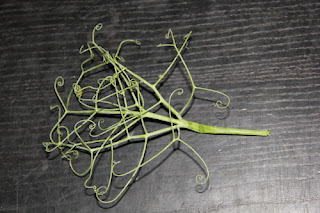
    The leaf on the left is from a Lacy Lady pea, the leaf on the right is a typical pea leaf (from a yellow snow pea)
    Semi-leafless peas in general are fantastic, yet at present there do not seem to be many (if any) varieties available to the home gardener.  Semi-leafless peas still have some leaves, but many of the leaves only grow as tendrils.  Older pea varieties all have compound leaves, each with many, small leaflets, and the terminal leaflet modified to form a single tendril.  The semi-leafless peas have more tendrils than leaflets.  The only flat recognisable leaf you will see on them is on the pea stalk itself.  These Lacy Lady peas have a recessive gene which produces a modification of the leaf morphology, this has not come about in a laboratory, or through any form of genetic manipulation, but simply through a random mutation that occurred in a field somewhere and has then been bred conventionally into this variety.  It is the same process that people used to create the first orange carrots, or the first red tomatoes, or many of the common fruit and vegetables that we enjoy today.

    At first I was worried that by having less leaflets they would be less productive as they would have a lowered level of photosynthesis.  After growing them for a few seasons and researching them a bit I have found that this is not the case.  The tendrils contribute to photosynthesis in a similar way to normal flat leaves so the plants are just as vigorous as leafy types.  Having less flat leaves they are less likely to be damaged by severe weather.  They are also far less inviting to ducks who happen to fly into your vegetable patch, so far the ducks seem to be more content eating the grass and weeds and leaving the lacy looking pea plants alone.  Regular peas, however, tend to be one of the first things the ducks eat if they happen to get in.


    One leaf from a regular pea - note the 6 flat leaflets and the tendril on the end
    As large flat leaflets are replaced by wiry tendrils, the foliage surface area is reduced significantly.  One of the benefits is that the plant is far more water efficient and can withstand hotter, dryer conditions than leaf type peas.  As I currently live in an incredibly hot and dry climate this is very useful for me.  For those who live in cooler and wetter climates this trait is still useful as it means less time is spent watering, some people claim that they never water these peas and they perform wonderfully for them.  If I were not to water them I would be left with a barren vegetable garden with no weeds and only hard baked clay.

    Another benefit is that with a lowered amount of foliage there comes a significant increase in ventilation, which means that less problems from things such as powdery mildew will be seen.  Where I live the ambient temperature is generally high and the humidity is low so we tend not to see many mildew issues, but for those in cooler damper climates this increased ventilation would be very beneficial.  I wish that I grew these when we lived in a cooler damper climate so that I could compare this from my own experiences.

    Leafless peas produce a tangled mass of tendrils, that combined with the fact that they are very short plants means that most plants can support themselves without trellising.  As they are much shorter than most pea varieties, I generally grow these sorts of peas without much in the way of stakes or support, aside from a single post-and-string setup around the outside of the bed.  I dont even know if this is necessary, I mostly do it as a force of habit.
    Lacy lady pea leaf
    One leaf from a Lacy Lady pea plant - less water loss, better ventilation
    I seem to have increasing difficulty in seeing green peas and beans in amongst green foliage.  For that reason I grow yellow snow peas and purple podded dry peas (which can also be used as regular peas, but in my opinion are better as a dry pea).  I have found that the lack of regular leaflets in the Lacy Lady peas has made it a lot easier to see the pea pods even though they are green.  The pods are fat while everything else is thin and wiry which makes the pods pretty easy for me to see.  Since the pods are easier to see due to the lack of leaves they are faster and easier for me to pick.  With more of the plants energy going into pod formation rather than growing large leaflets, they tend to have higher yields than many other varieties of pea.  This variety also tends to produce multiple flowers at each node, which again means a high yield.  Even though this is a short strain of pea the yield seems to compare or surpass the larger varieties that I have grown.

    Aphids are more easily controlled by ladybird beetles and other predators on leafless pea plants.  Pea leaves are slippery whereas stems and tendrils provide a more secure footing.  Apparently ladybird beetles fall off normal varieties with flat leaves nearly twice as often as the leafless plants.  This makes them good for organic gardeners, permaculturalists, and for gardeners who control pests and diseases using Integrated Pest Management (IPM).  We tend not to use any poisons here, organic or synthetic, so I often try to find plants such as this with a natural defense against pests or diseases.

    The only disadvantage that I have noticed is that being a dwarf pea at the end of the season when the plants are dead you are not left with much pea straw to use on the garden.  This is not a terribly bad thing when you consider how many benefits they have and that I can easily remedy this by also growing another variety of pea.  I grow a few types of pea, one shelling pea, one snow pea, and one dry pea, as well as a few crosses which I am making to try and improve upon other varieties.  Both the snow pea and the dry pea are not dwarf varieties, nor are most of the crosses, so I usually end up with plenty of pea straw from them.

    Read More..

    Senin, 18 April 2016

    Newborns letter to mummy


    Dear mummy

    I like it when you wear me in your sling and hold me close to your heart.
    I listen to you breathing where I feel safe and calm.
    I love to fall asleep in my sling,
    I listen to your heart and when my eyes start to wake I see your smiling face, it hasnt gone away.

    Mummy did you know the world is very scary.
    I hear so many sounds, I cannot see what or how big they are,
    but when I hear your heart I know that you cannot be far
    I know that you will keep me safe and I will not meet harm.

    So mummy next time I fall asleep on your chest, please oh please keep me there. Let me listen to your heart and hear your gentle breath. Let my eyes peek open and see that you have stayed where you were left. I love being so close to you mummy and being where you are. You are my safe and gentle place in this very scary world. There is so much for me to learn mummy, please stay with me while I do. I promise one day I will run away and learn all by myself. So hold me close now while you can and smell my tiny head, kiss my cheeks and whisper in my ear.

    From
    your gorgeous little newborn who doesnt like to be put down.


    Read More..

    Rabu, 23 Maret 2016

    Yellow podded snow peas


    We grow a few types of pea at the moment, one that gets a lot of nice comments from people are the yellow podded snow peas.

    I have trouble seeing green pods in amongst green foliage, so I have to find ways to work around this.  You may not think that this would matter too much, but if you do not pick pods every day and one starts to get too old the yield is lowered considerably as the plant will stop putting energy into flowers/new pods and concentrate its energy on developing seeds.  The yellow pods are easy to see in amongst the green foliage, this makes harvest fast, easy, and increases productivity.

    permaculture vegetables
    Yellow podded snow peas and flowers
    The yellow podded snow peas are an old heirloom variety of pea dating back to at least 1860.  It is likely that this variety of pea was one of the ones used by Gregor Mendel when he was doing his famous pea breeding and working out the basics of genetics and inheritance.  A lot of the peas I grow have at least one trait that Mendel used in his pea inheritance trials, I find it very interesting.  I also like how simple it is to breed peas, especially when the genetics behind them is relatively well understood and is mostly not too complex.

    For some reason yellow snow peas never really took off and no significant breeding work has been done with them.  This lack of serious selective pressure means that they have a lot of potential for anyone who wishes to breed them into something better.  I am doing a little pea breeding trying to make an improved yellow podded pea, but that is a long way off being completed (if I do continue to pursue it).  I keep the original pure strain isolated and am always careful when saving seed as I think that this strain is worth preserving.  I know that there are a few other people in the country who are using these to breed superior yellow podded snow peas, hopefully one day they produce something great and distribute it.

    As a producer of food the yellow podded snow pea is superb.  It reaches five or six feet tall so it needs to be grown with some support.  It is a very vigorous grower, it is fast-growing and its yields are abundant.  Each plant seems to yield dozens of pods even with minimal effort on my behalf.  These peas are unlike many varieties in that they produce several flowers at some leaf axils, yet produce only one flower at others.  I do not understand why they do this or how to breed for more uniformity in double flowering.  At this stage it doesnt matter much as they do produce a lot of pods.  As well as producing a lot of pods they are rather tall plants, so at the end of the season they provide me with a decent amount of pea mulch to use on the vegetable garden (unlike the Lacy Lady peas that I mention in another post).

    yellow podded snow pea Australia
    Yellow snow peas, so abundant and vigorous their weight broke the support stake
    The plants are attractive from quite an early stage.  They have a pink/red splash in the leaf axils which is normally only seen in purple podded peas.  The leaves are also slightly yellow as opposed to the deep green of regular peas.  Once flowering has got underway, the stems, leaves and tendrils become increasingly yellow.  The flowers also seem to change colour as they grow older.  They start out pink, then go through purple to end up blue.  Again this is similar to the purple podded peas, but the yellow snow peas seem to be more vivid in their colour change.  The flowers are very beautiful, people often comment that they thought I was growing the ornamental sweet peas rather than something edible.  It is nice to grow something so beautiful that produces so much food, it also means that if you were to grow them in town people would be less likely to steal them.  Once the flower has begun to fade the yellow pod emerges. 

    permaculture vegetables Australia
    Several flowers and a young yellow pod - note the pink stem and purple splash on the leaf axil
    This variety is usually grown as a snow pea, but could be used as a shelling pea or a dry pea if you wanted to.  If you harvest the pods while theyre still young and about half the size you would expect from a snow pea they are reasonably sweet and crunchy, so you can eat them raw straight off the plants or put them in a salad.  As the pods get bigger the colour fades to a pale greeny-yellow and they dont taste anywhere near as sweet .  I am told that they are still good for cooking at this stage, but am yet to try it as they are not so good raw so I normally either pick them small or let them go to seed.  Larger pods also start to develop string which is certainly not something that a great snow pea does.  Once the peas start bulging out visibly, youre better off leaving them to develop into seed for next years crop.

    Yellow podded pea foliage, slightly yellow leaves and slightly pink stem
    The seeds themselves go through amazing colour changes as they dry out and finish up with speckles and patterns, all different.  I have even had one seed that was completely purple!  I will try my best to grow this purple seed next time and see if that trait continues.  The colours of the seeds are at their most intense a few days after harvest.  They look as though theyve been splattered with ink.  The speckles are at their most sharply defined and intensely coloured when the pea is allowed to dry inside the pod, especially those parts which are in physical contact with the pod.  Any parts of the pea which are exposed to air (even inside the pod) develop a softer and more blurry speckling.  You get to see every pea within the pod developing its own unique pattern of coloured speckles while the peas themselves adopt various shades of green or tan.  I think that it is amazing and beautiful.


    Yellow snow peas and their flowers - yellow pods are easy to see and harvest

    Overall I am happy with this type of snow pea and will continue to grow it unless  something better comes along.  There may be more tasty varieties of snow peas out there, but none I have grown are as beautiful and as productive as these.  As long as we eat them small they taste just as good as any other type of snow pea.
    Some of the yellow snow pea seeds

    I do sell seeds of the yellow podded snow peas on my for sale page whenever I have some to spare. 

    Read More..