Tampilkan postingan dengan label fun. Tampilkan semua postingan

Selasa, 17 Mei 2016

Another corn update


This is a follow up from my previous corn post.  These are just some of the more unusual varieties I grew this year.  At this stage I dont know if I will be able to grow corn next year, but we will see what happens.  I will have the seeds to plant the following year so if I do end up missing a year or two it is not the end of the world.


Argent
The argent white corn ended up doing a lot better than I thought it would.  Very few of the super sweet corns cope with extreme heat, most died off completely.  I love this variety, it is the most delicious variety of corn I have ever eaten.  Most of the cobs were not completely filled out due to the heat and some of it was crossed with another variety of corn (this was deliberate, it is simple to tell which seeds are which) and I ended up with what looks like a good amount of pure seed.

I expected less seeds to form than I ended up getting so am pretty happy.  I have had a severe genetic bottleneck here by starting with so few parent plants so plan to grow out as many seeds as possible next time.  If possible I would love to track down someone who is also growing argent and swap some seeds.

I deliberately crossed the argent with another variety of corn.  The F1 seed is coloured and the pure seed is white so can easily be separated.  I would love to grow out the F1 seed and produce a stable strain, but I may not have time or space so we will have to wait and see what happens.  I may even ask for someone to do a growout of some of this seed.

Some of the poorly filled out Argent cobs, white seeds are pure and coloured seeds are deliberate crosses


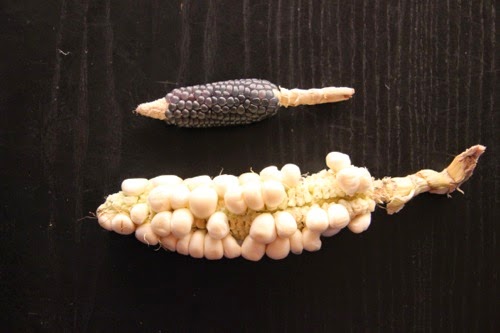
Giant Incan White corn
Watching this corn grow was amazing, it was different from every variety I have ever seen.  From a distance it is easy to tell this apart from every other variety.  It grew huge, then the heat damaged a lot of the plants.  Most varieties of corn will not shed pollen if the tops are damaged (making F1 seed simple to produce) but this variety decides to sprout and grow new tassels.  It is very resilient.  Each plant grew a cob, then they grew half a dozen more cobs from the same point!  I have never seen this trait in any other variety of corn.  Unfortunately I got very few cobs with any seeds due to the weather and wildlife.  These cobs are drying at the moment, it looks like I will get a small amount of seed from these.

One cob, you can see more cobs starting to form underneath

Cobs forming 7 feet up the stalk, the leaves all have damage from the heat

The cob was just starting to produce silk
Giant Inca white corn next to mini blue popcorn


Glass Bead corn
What can I say, these guys know what they are doing.  Nothing particularly bothers glass bead corn.  It is now a good popcorn, in another year or two if things keep going the way they are going it will be a great popcorn variety.

Mini blue popcorn
This was damaged by the heat badly but still provided a decent yield.  The plants grew well, the cobs look great and are mostly well filled out and the seeds pop extremely well.  The plants had to compete with grass and had a small fruit tree close by with roots under them.  My kids think this popcorn is heaps of fun.  I wrote a separate post on this little guy.

Blue popcorn plants - growing well in less than ideal conditions

mini blue popcorn cobs - not too bad considering the growing conditions


Blue sweetcorn
This is actually a decent variety of corn, I dont know why I have not heard of it anywhere else.  I got a good number of cobs, most were poorly filled out due to the weather.  I like the look of blue corn so plan on growing this again.

Blue sweetcorn, poorly filled out cobs this year but it produced a good number of seed.


I am selling seeds of some corn varieties but not others.  At this stage I can not sell seeds from every variety, hopefully one day I will be able to do that.  Please visit my for sale page if you are interested.

Read More..

Sabtu, 14 Mei 2016

Fun with Colour


Read More..

Minggu, 01 Mei 2016

Non flowering Sorrel in Australia


Sorrel is a perennial leaf vegetable that I always considered growing, but was not sure how good it is or if I would like it.  It is reasonably difficult to find so I never bothered tracking it down.  Living in such an extreme climate I do not have space or water to waste on novelty vegetables, I need hardy and productive plants.  We also dont have the money to throw away if it turned out not to be worth growing.  

Every source of sorrel I can find only had seeds, no one seemed to offer plants and the seeds were seemingly from poorly maintained stock and never from improved plants.  I considered buying some seeds, but dont want to waste money on inferior plants or start another breeding project.  One day someone kindly offered me a sorrel plant in a trade.  They offered it as well as something that I really wanted so I figured I had nothing to lose.

Sorrel plant

When the sorrel turned up it was a small red green stump with no leaves and very few roots.  Apparently that is how they are best posted and it is how they settle in the fastest.  I planted it and figured it would be a few weeks before I saw any real growth or got to try a leaf.  The next day it had a new leaf and a few days later it had grown several leaves!  I tried a tiny piece of a leaf to see what it tastes like.  It was like any leaf vegetable really but also lemony.  My kids love lemony things and often eat anything sour that they can find so I was happy.

It did not take long before I was able to divide the plant.  I divided it several times by digging it up, ripping it into pieces each with a growing point, removing the leaves, and replanting.  Winter came and the growth slowed, frosts did not seem to worry it.  Some people say that it goes a bit dormant over winter, this may be the case but my winters can be mild and it did have some protection so it kept growing.  Over spring it grew like crazy, I should have divided it into a bunch of plants but kind of forgot about it.  Summer hit pretty hard, the leaves got burned by the heat a few times (as did the leaves of every fruit and vegetable I grew this year) but they kept on growing.  When the weather cooled down the sorrel took off again, this time I dug it up and divided it a little.  When dividing sorrel they do best if you cut off all of the leaves, it seems harsh but it will grow new leaves soon enough.
Sorrel leaves ready for cooking/eating
I have read that sorrel usually has separate male and female plants, sometimes it has a plant that has male and female on the same plant, rarely the highly sort after non-flowering plants turn up.  Flowering stops leaf growth for a while and also makes the leaves bitter so growers often talk of removing flower heads to extend the leaf harvest.

This plant was seed grown by its previous owner so it could have been anything.  After growing it for a while this appears to be a non-flowering (or at least very reluctant to flower) individual.  This means that instead of putting energy into flowers and seeds it puts all of its energy into leaf growth and dividing itself.  It also means that there is no chance of it becoming a weed or crossing with anything else.  When regular sorrel flowers the leaves become coarse and inedible for a while, by not flowering this plant has a much extended harvest period each year. 
Sorrel leaf - non flowering means more leaves

As far as I am concerned, this plant is exhibiting every trait that I would have tried to breed for, this is an improved variety!  There is apparently a variety of sorrel sold overseas known as "Profusion" which sounds similar to mine.  As profusion does not flower (so it does not set seed) and importing the plants is next to impossible my variety is the closest thing we have in Australia.

Growing sorrel is simple.  It likes water, good soil and full sun but grows happily enough if it is a little dry or in the shade or with poor dodgy soil or with competition from other plants.  I have yet to see any pest or disease issues of any kind but am told that a leaf miner bothers it in some gardens.  They say if a leaf has leaf miner to remove that leaf, destroy it, and the problem is solved.  Apparently if the plant gets a lot of leaf miner before you notice you can remove all the leaves and destroy them, sorrel will grow new leaves soon enough.

Sorrel has deep roots so mines nutrients from the subsoil and brings them to the surface in its leaves.  The soil life under sorrel is amazing and healthy.  Permaculturalists grow sorrel as a dynamic accumulator and a compost activator.  It out yields comfrey tremendously on my property, lacks the irritating hairs of comfrey, and unlike comfrey seems to be readily eaten by poultry.  I consider all of this a win.
Small sorrel plants a few weeks after being transplanted and having all the leaves removed
Being perennial means it is low maintenance, I plant once and then can forget about it and know that it will still be there if I want to harvest it, I do not need to collect seeds or remove flowers or anything like that.  Sorrel is nutritious, like many leaf vegetables it is very high in vitamin C.  Many people say that they do not let sorrel flower so that leaf growth is encouraged, with my sorrel this is unnecessary as it does not flower most years.

There are a lot of old (pre-1900) recipes that include sorrel as an integral component of the dish.  Some dishes contain sorrel and very few other things, this is not just a nice herb or a garnish, it is a decent vegetable.  Today sorrel features as a garnish, is often used when cooking fish to impart a lemon taste, is occasionally made into a fancy French soup, and is one of the main ingredients of green borscht.  You can eat sorrel raw but it is high in oxalic acid (like many other vegetables) so it is best not to eat too much.  Oxalic acid is water soluble and cooking removes most of it so you can eat cooked sorrel to your heats content.

Sorrel was commonly grown in every vegetable garden all over the world for hundreds of years then it pretty much disappeared overnight.  I know of very few people who have ever grown or tasted or even know of this productive plant.  The reason for this is that sorrel can not be harvested and stored and shipped to consumers, it must be harvested and used pretty much immediately.  For a reliable supply you must grow your own, but that is very simple to do.  For many years now people have stopped growing vegetables because they have no land, as such they miss out on tasting treasures such as sorrel.  

I hope that more people grow sorrel, I especially hope that more people grow improved non-flowering forms such as this one.  I would hate for this to disappear if I happen to lose my stock.  I am planning on building up my sorrel in Spring, until then I can sell it in small numbers through my for sale page.

Read More..

Minggu, 24 April 2016

Daisy


Meet Daisy our very beautiful Jersey. Who apparently does not like us. She handled beautifully for her previous owners but wont let us touch her. This is a bit of an issue since we would like to milk her.

She is currently pregnant to her first calf, which is due in a few weeks. We are working intesively with her in the hope she will let us milk her. I am doubting she will.

Not to sure where to from here. Do we aim for another adult in milk or get ourselves a poddy calf to raise, so she will be very use to our property and being handled by us.

Hopefully we get to milk Daisy, as I cannot wait to be supplying our own raw milk.


Read More..

Minggu, 20 Maret 2016

Fun with strawberry phyllody


My little boy Nanuq grew some strawberries.  At first they were normal strawberries, then they changed.  Just like Nanuq these strawberries are a little odd, kind of complicated, and more than a little bit crazy.   I think that they (both Nanuq and the strawberries) are a bit cute.

I like the look of these strawberries, they are all covered in tiny little bracts instead of tiny flowers and fruits (the part people refer to as seeds).  This condition is known as "phyllody".  I hope that they keep doing this.  We have taken the following pictures.


I am certainly no expert in strawberries so asked a few people who breed them.  I have tried to find out what has caused this and if it is a bad thing, there seem to be three different possibilities that have not been completely ruled out at this stage.

First is "green petal disease".  This is caused by a mycoplasma like organism (often confused with a virus) which is spread by leaf hoppers.  It is a disease which can infect clover.  It can cause phyllody to be expressed in the flowers/fruit.  If this is the cause then the plants should be removed and burned as they will not recover and may infect other plants.  I certainly dont want to infect other plants as I like to eat regular strawberries.  I doubt green petal disease is the cause as the petals are white and it is not showing some of the other symptoms.

The second is a genetic weakness.  This is often seen in varieties such as "malwina" or in some varieties when the runners have been cold stored.  From what I have read they sometimes recover, sometimes dont.  There is a variety of strawberry called the "plymouth strawberry" which showed this trait many years ago and has never recovered.  It only reproduces via runners as it can produce no seeds as it forms no true flowers.  There is a chance that this is part of the cause even though I dont believe that phyllody has been observed in this particular variety before.

The third possibility is the weather.  The plants grew through the hottest and longest summer I have ever experienced, somehow missed out on Autumn, and are now in a weird winter with mostly warm/hot days and cool/cold nights.  If this is the case the plants should recover and produce normal strawberries.

My best guess is a combination of the last two, weird weather combined with a genetic weakness.  If this is the case then we may see some normal strawberries soon or it may keep doing this. I kind of hope they continue to make these crazy strawberries but do not infect any other strawberry plants.  If this is the case then I will try to distribute the plants to interested people.

I do sell some heirloom and perennial vegetables as well as herbs on my for sale page, at this stage I do not sell strawberries but may do so in the future.

Read More..