Tampilkan postingan dengan label everlasting. Tampilkan semua postingan

Selasa, 17 Mei 2016

Another corn update


This is a follow up from my previous corn post.  These are just some of the more unusual varieties I grew this year.  At this stage I dont know if I will be able to grow corn next year, but we will see what happens.  I will have the seeds to plant the following year so if I do end up missing a year or two it is not the end of the world.


Argent
The argent white corn ended up doing a lot better than I thought it would.  Very few of the super sweet corns cope with extreme heat, most died off completely.  I love this variety, it is the most delicious variety of corn I have ever eaten.  Most of the cobs were not completely filled out due to the heat and some of it was crossed with another variety of corn (this was deliberate, it is simple to tell which seeds are which) and I ended up with what looks like a good amount of pure seed.

I expected less seeds to form than I ended up getting so am pretty happy.  I have had a severe genetic bottleneck here by starting with so few parent plants so plan to grow out as many seeds as possible next time.  If possible I would love to track down someone who is also growing argent and swap some seeds.

I deliberately crossed the argent with another variety of corn.  The F1 seed is coloured and the pure seed is white so can easily be separated.  I would love to grow out the F1 seed and produce a stable strain, but I may not have time or space so we will have to wait and see what happens.  I may even ask for someone to do a growout of some of this seed.

Some of the poorly filled out Argent cobs, white seeds are pure and coloured seeds are deliberate crosses


Giant Incan White corn
Watching this corn grow was amazing, it was different from every variety I have ever seen.  From a distance it is easy to tell this apart from every other variety.  It grew huge, then the heat damaged a lot of the plants.  Most varieties of corn will not shed pollen if the tops are damaged (making F1 seed simple to produce) but this variety decides to sprout and grow new tassels.  It is very resilient.  Each plant grew a cob, then they grew half a dozen more cobs from the same point!  I have never seen this trait in any other variety of corn.  Unfortunately I got very few cobs with any seeds due to the weather and wildlife.  These cobs are drying at the moment, it looks like I will get a small amount of seed from these.

One cob, you can see more cobs starting to form underneath

Cobs forming 7 feet up the stalk, the leaves all have damage from the heat

The cob was just starting to produce silk
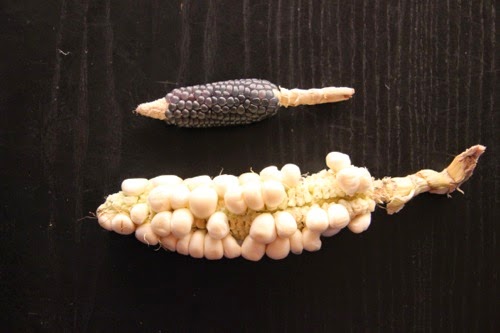
Giant Inca white corn next to mini blue popcorn


Glass Bead corn
What can I say, these guys know what they are doing.  Nothing particularly bothers glass bead corn.  It is now a good popcorn, in another year or two if things keep going the way they are going it will be a great popcorn variety.

Mini blue popcorn
This was damaged by the heat badly but still provided a decent yield.  The plants grew well, the cobs look great and are mostly well filled out and the seeds pop extremely well.  The plants had to compete with grass and had a small fruit tree close by with roots under them.  My kids think this popcorn is heaps of fun.  I wrote a separate post on this little guy.

Blue popcorn plants - growing well in less than ideal conditions

mini blue popcorn cobs - not too bad considering the growing conditions


Blue sweetcorn
This is actually a decent variety of corn, I dont know why I have not heard of it anywhere else.  I got a good number of cobs, most were poorly filled out due to the weather.  I like the look of blue corn so plan on growing this again.

Blue sweetcorn, poorly filled out cobs this year but it produced a good number of seed.


I am selling seeds of some corn varieties but not others.  At this stage I can not sell seeds from every variety, hopefully one day I will be able to do that.  Please visit my for sale page if you are interested.

Read More..

Senin, 25 April 2016

Everlasting Onions


Everlasting onions (Allium cepa perutile) are a rare perennial onion which is extremely productive and undemanding.  They do not appear to suffer pests or diseases, frost does not bother them, and if it gets too hot and dry they die down to bulbs.  I do not know why but I do not know of anyone else who has everlasting onions for sale in Australia.  They are one of the easiest and most productive vegetables to grow, just like all perennial vegetables you plant once and harvest forever.

I first heard about everlasting onions from someone who lives overseas.  They told me how great they were and said that they were extremely rare for some reason.  Importing onion plants/bulbs is more trouble/expense than I can deal with.  Importing onion seed is less difficult but everlasting onions never really set seed so this was also out of the question.  I then started to search for them in Australia.  No one seemed to sell them, it took me years to track them down in Australia.  Eventually I found someone who sold me some small plants.  She had these plants for well over 30 years and said that they flowered each year but had never set seed.  This sounded right so was worth a try.

Everlasting onions
Everlasting onion bulbs sprouting - normally they are far larger than these


At first I was skeptical that I had in fact got the right thing.  They looked like any spring onion or young onion plant before it bulbs up, but the plants were extremely uniform in size.  I planted them somewhere safe and waited.  In a few weeks most had split in half so I dug them up and divided them.  A few weeks later the rest had split in half so I divided again.  In another month or so they all divided again at least once, some of them divided a few times.  By this stage they were no longer uniform in size and I grew tired of digging them up and dividing them.  I now had a few dozen plants and was convinced that they were better than regular spring onions. 

Once winter hit these plants were not at all bothered by frost.  The growth slowed somewhat but other than that they looked happy and continued to divide.  Spring was great, they grew faster, divided faster and began to flower.  The flowers did not look complete and they did not even try to set seed.  They looked like Allium cepa flowers rather than Allium fistulosum, so I was then convinced that they were not ordinary spring onions and were most likely true everlasting onions. 

When summer rolled around some kept growing but most I let dry down to see if they produced bulbs.  They ended up growing small purple bulbs, a bit larger than a french shallot.  Being new to everlasting onions I decided not to eat the bulbs, instead I replanted them.  Each bulb divided into a dozen or more plants when it resprouted!  Over the past few years I have let some die to bulbs each year, if they are crowded they produce small bulbs, if they are given space the bulbs are much larger.

How everlasting onions are used


Once you grow everlasting onions you will never need to buy spring onions or shallot bulbs ever again.

We eat the green tops year round in place of spring onions.  Unlike spring onions they never get too thick and fibrous.  I have some spring onions that I planted as seed when we moved here, they are large and thick and a bit too fibrous to eat.  I do not have the heart to kill them, but do not know how to make them small and delicate again.  Cutting them to the ground helps but it does not take them long to turn into monsters again.

If we keep watering the everlasting onions over summer they keep growing, if we dont water they die down to nice little bulbs.  The bulbs can be used as salad onions, they are good for this purpose.  The bulbs seem to store forever, I dont know how long but it is at least several months.  We have fried the onion bulbs, they are nice but become very crunchy.  I think they must be reasonably high in sugars as they caramelise rather quickly.  Everlasting onion bulbs can be used in any recipe that calls for onion bulbs or french shallots.
Everlasting onion bulbs - they can be larger or smaller than this

How to increase your stock

Everlasting onions know what they are doing as far as reproduction goes.  They split in half numerous times throughout the year.  If they are divided each division will also multiply.  Neither heat nor frost bothers them.  It does not take long for a few to become a decent patch.  Like any other onion, if you plan to eat the bulb you do not have to kill the plant.  If you cut off the roots with a few mm of the base of the bulb this can be sprouted and replanted.  I have only done this once as I now have enough plants that they quickly replace any that we eat.

Everlasting onions are hardy, I planted one under a tree when I got them.  I do not water or weed this one after it was established, I had actually forgotten all about it.  This summer it was so hot and dry that we had no grass and I saw that it has divided into a substantial clump and is still hanging in there.  They are not as large or numerous as the ones that are well watered and weeded, but they are surviving and reproducing.  Planting an extra plant in an out of the way like this is a great way to increase your stock as you tend to forget about them for a while and when you find them again they tend to be rather numerous and in need of digging up and dividing.

The lady who I got the everlasting onions from had them flower each year for 30 odd years and had never seen any seed produced ever, the first few years I had similar results.  This year after they flowered I had a small number of seeds produced.  From several hundred flower heads I ended up with about 30 seeds.  I planted some of them and have a few seedlings appear.  I have no idea what they will turn into, perhaps exactly like their parent or perhaps something entirely different.

I have heard of someone who grew potato onion seeds and ending up with something very similar to my everlasting onions.  That makes me wonder if everlasting onions are another type of potato onion that was seed grown many years ago.  If so the results from the seed grown plants should be extremely interesting.

Where to find everlasting onions in Australia

To the best of my knowledge no one else is selling these other than me.  I am happy to be wrong on this as they are a great vegetable and more people should grow them.  I have everlasting onions for sale all year, they are listed on my for sale page along with some other perennial vegetables and heirloom vegetable seeds.

Read More..

Kamis, 17 Maret 2016

Reisetomate tomatoes in Australia


A while ago I heard of an ancient Peruvian heirloom tomato that did not grow round or oblong like most tomatoes, but grew segments that one could separate like a mandarin or an orange.  This tomato could be eaten one segment at a time without the use for a knife.  This sounded intriguing, I wanted to see a tomato like this.

After some research I found that it was called "Reisetomate".  I saw some pictures of it and it did indeed have segments like an orange.  The fruit looked amazing but I was concerned it may be just a novelty tomato.  I have no time for novelty vegetables so I wanted to know more.

Reisetomate tomato segments
Reisetomate tomato with some segments removed
Apparently it is an incredibly rare and ancient heirloom variety.  This variety may actually predate the Spanish conquistadors going to South America.  There are unsubstantiated stories of this variety being used by the Incas when they were traveling and tearing off a segment at a time to eat.  The name Reisetomate is apparently German and means "traveler tomato" eluding to the fact that this variety is carried on trips to be eaten without the use of a knife.  I also hear that this is one of the varieties of tomato that the Amish grow, if this is true then this variety is a no-nonsense productive variety.  I became more curious and wanted to grow one.

I wanted to try this variety, but they are so rare that it is difficult to find anyone who has seeds.  Tomato seeds can not be imported into Australia without huge trouble and expense so I had to find somewhere local to purchase seed.  After searching I found only one place which had Reisetomate seeds for sale in Australia.  There were not even any dodgy ebay sellers which I had hoped to see as they can drive the price down a little.  The one company that sold them was demanding an outrageous price for a small number of seeds and was a company which I have had a lot of trouble with in the past.  I rarely buy seeds anymore so there is a chance that company has lifted its game.  I did not know if the risk was worth it and was about to give up on trying to grow Reisetomate tomatoes.  


Luckily a friend of mine kindly bought me the seeds as he knew how excited I was about this variety.  I waited for weeks and the seeds never arrived.  Several weeks later my friend contacted the company and they then sent out the seeds.  I planted some seeds and kept some in case things went wrong.  Tomatoes are simple to grow from cuttings so I figured planting a small number of seeds would be ok as I could still get a large number of plants by taking cuttings.

The plants were growing well and were about to flower, then the heat of summer hit.  The flowers are not like an ordinary tomato flower, they an odd and multiply fasciated flower, some with exposed stamens and pistils.  Like many heirloom tomatoes this variety will cross pollinate with other tomatoes.  Apparently this variety is notorious for cross pollinating with other tomatoes so I was careful to plant it in a separate vegetable garden to my yellow pear tomatoes.  This is one of the positives to having two vegetable gardens spaced so far apart.

Reisetomate flowers
Reisetomate flowers

The plants all flowered and grew well, but the temperature was too high and the flowers withered and died.  Apparently temperatures in the mid 40s denatures tomato pollen and prevents fruit set.  Cooler nights may have helped overcome this, but the nights dont always cool down out here over summer.

The plants grew about 5 or 6 feet tall and probably would have grown a lot taller if they had more water, protection from the heat, and better soil.  Many of the stems are covered in small roots searching for soil and anywhere the stems touched the ground they firmly rooted.  After a little over 9 weeks of daytime temps in the 40s the weather cooled down (to the high 30s) and the plants started setting a lot of fruit.  The tiny green fruits looked very odd, kind of like weird little green brains, and gave me a good idea of what the fruit would look like when it ripened.

unripe Reisetomate tomato fruits
Unripe Reisetomate tomatoes - very productive plants
ripening Reisetomate fruits
More unripe Reisetomate tomatoes
When the first fruits began to ripen I was perplexed.  Each fruit is like a cluster of small tomatoes fused together with many odd lobes.  The first set had one or two lobes on each fruit that looked like it was rotten so I did not know what to do.  After picking them I found out that the rotten looking lobes had been infected by fruit fly.  It was simple to remove and discard the infected lobes, then the rest of the fruit was unharmed and fine to eat.  After the first few I got on top of the fruit fly and all of the tomatoes were fine after that.

permaculture tomatoes
Ripe Reisetomate tomatoes
These tomatoes have provided large yields, far larger than any other variety I have grown.  I can not imagine how productive they would be in a more mild climate.  I have read some seed sellers claim they produce 1.1kg per plant and others claim over 25kg per plant, mine produced somewhere in the middle.  They are the highest yielding variety of tomato I have ever grown.  Perhaps next year I will weigh all the fruit from one plant to find out for sure.  They seem to survive through some light frosts with no issues but I am guessing the heavy frosts will kill them.  I am told in climates without frost they can be a short lived perennial which survive and produce for half a dozen years.  I am also told that without frost the stems can get as thick as your wrist after a few years and can only be cut down with a chainsaw.  After growing these under difficult circumstances and seeing how strong and determined they are I believe this is entirely possible. 
Reisetomate tomato
Reisetomate tomato, simple to pull apart segments

After tasting these tomatoes I want to grow them each year from here on.  The taste is amazing, they are by far the best tasting tomato I have ever eaten.  They have a deep and strong taste, they are not sweet or insipid like some cherry tomatoes. Sometimes they can be a bit too sour, a little salt reduces that and brings out their full flavour.  I love their intensity, just thinking about it makes my mouth water... 

We use these tomatoes fresh pulled apart in segments.  I love them like this and it is my favourite way to eat them.  We also use them cooked in any dish that requires tomato, they seem well suited to this and bring a depth of flavour and complexity to a dish that many tomatoes lack.  We slice them for sandwiches and the like, they taste amazing but their odd shape makes them less than ideal for this purpose.  They can be pulled apart and put into salads like a cherry tomato.  Being so intense and full of flavour I assume that they would make a decent sauce or paste but I have not tried this myself so cant be certain.

The question I keep asking myself is why these are so rare.  Many things are rare because they are not worth having or are too new.  Reisetomate tomatoes are older than any other variety of domesticated tomato that I know of, they taste amazing, yield tremendously high, apparently have disease resistance (I do not have tomato diseases so can only go off what I have read), and look great.  I can only assume their rarity is due to being unfit for mechanical harvest.

These plants show a lot of diversity of their fruit.  On one branch of a plant you will have some fruit that split into perfect segments as well as some fruit which does not split as perfectly.  Apparently this is mostly due to growing conditions rather than genetics.  I only save seed from the plants which have most of its fruit which splits cleanly and evenly into segments, I only save seed from the best fruits from those plants, I figure this is worth doing even though I dont know how heritable this trait is.

I do sell Reisetomate tomato seeds, I have them listed on my for sale page.

Read More..