Tampilkan postingan dengan label pack. Tampilkan semua postingan

Sabtu, 07 Mei 2016

Commercial Backyard Aquaponic System Wolf Pack Aquaponics
Wolf Pack Aquaponics

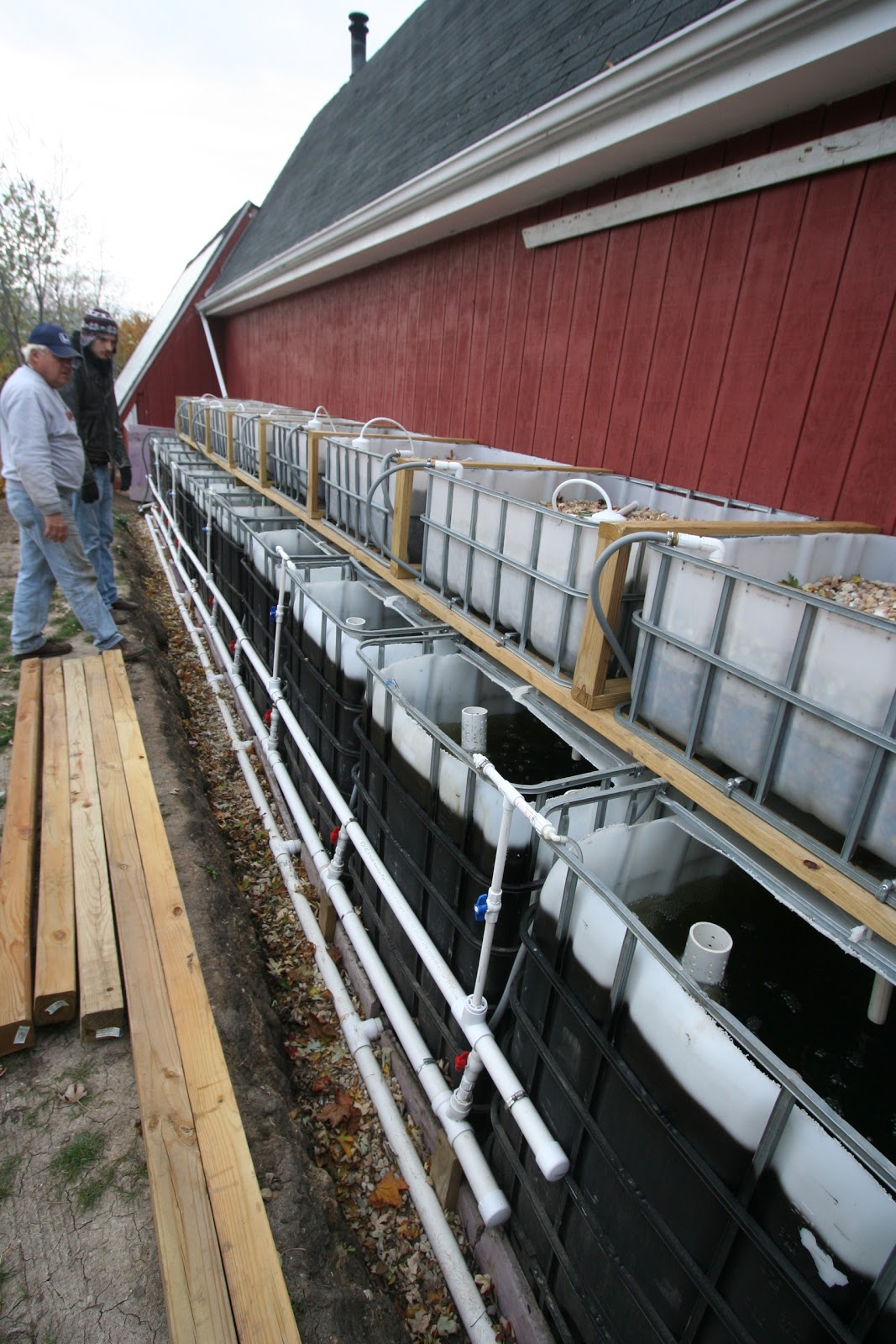
Outside the Wolf Pack Aquaponic greenhouse backyard system commercial

When people get into aquaponics, they usually get the idea of setting up a big system in their backyard. While there are plenty of factors that halt their idea, cold climates, lack of funds, a nagging wife/ girlfriend who does not want an ugly system in their yard, etc. But nothing stopped the Wolf Pack Aquaponic crew from setting up their backyard system. 

The tour started off with the water collection system that can collect over 300 gallons every time it rains one inch! The tour continued to the back side where there was eight or so 300 gal IBCs with half 275 gal grow beds on top. There is currently only a lonely blue gill swimming around, but once summer comes again they will be filled with home grown tilapia. Each grow bed fills and drains via an auto-siphon into the fish tanks below. Each IBC is connected with each other with a four inch PVC pipe so the fish can swim from one container to another. 
Inside the Wolf Pack Aquaponic greenhouse backyard system commercial
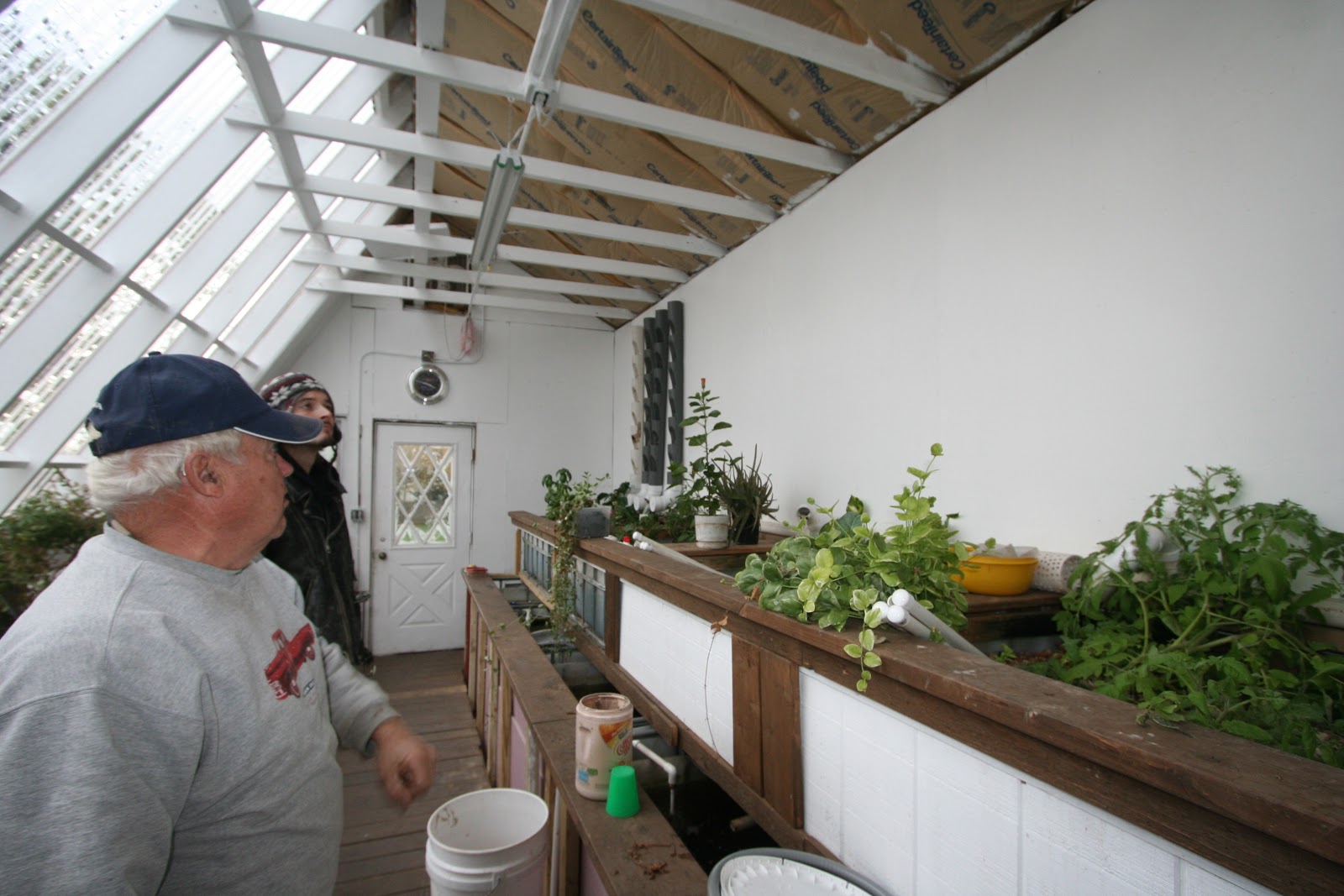
Inside the Wolf Pack Aquaponic greenhouse.


Inside the greenhouse there are IBCs on each side, but you barley notice them as IBCs. They are tastefully covered and look great! There are lots of plants growing but most have been harvested for the winter. One cool thing is the whole system is run off of one hot tub heater. This includes all the IBCs outside too! The pump doubles as a heater too, keeping the water temp suitable for tilapia. The pump does have a draw back, the cost of running it. It costs about $2-$3 a day just to run the heater pump. Although it does not sound that high, consider the pump is running 24/7, 365 days a year. That is $730 to $1,095 a year just to run the heater pump. Plus you need to factor in the cost to run the air compressor that provided air to each and every fish tank and DWC grow bed. 

Inside the Wolf Pack Aquaponic greenhouse 2 backyard system commercial
These are the floating raft beds (DWC).
This is where they start seedlings for transplant.

The fish tanks that lead to the floating rafts are filtered with a swirl filter. A swirl filter skims clean water off the top of the container while the heavy solids "swirl" to the bottom, also called a vortex filter. All of the solid fish waste that is collected is used as fertilizer for the "traditonal" garden outside. The plants love it! There were more tomatoes then they could eat, and pole bean galore! 
While the system is just feeding the Wolf Pack family for right now, they have plans to expand and have different offers that they are entertaining. There is lots and lots of work that went into making this system as well. The knowledge is being kept and collected to share with the public in the future. A "this works and this doesnt" manuel for aquaponics. 
Read More..

Kamis, 05 Mei 2016

Reliable Aquaponics Siphon

Hello everyone. It has been for so long that my problem in aquaponics is the "siphon reliability". Since most of my previous aquaponics system powered by small aquarium pump, therefore the siphon effect most of the time failed.

Recently, I have wondering, how to make the siphon more reliable even if the flow rate of the pump is really small. This is what I manage to come out so far.


Feel free to comment. I really have no idea whether this thing could work.
Read More..

Senin, 02 Mei 2016

Cloth Nappying


We discovered a lovely surprise on arrival to Mudflower ..... there is no electricity or water pressure in the laundry.

At what point did I discover this you ask? Well it was AFTER the removalists had placed the machine in the laundry and I went to try and wash 4 days worth of nappies.

Could this pregnant belly and Damos broken spine move the machine into the bathroom where there is pressure and electricty? Not likely.

So what did we do? We ran an extension cord into the house and bucketed the water into the machine. Not a great deal of fun and this is how we will have to continue with washing until we get things fixed up.

We have had an electrician out to have a look and he will get to it when he can. I think he may just be the farmer across the paddock who does work for those he knows, our other neighbour recommended him. So we will just sit tight on that one. As for the water, the laundry is gravity fed from a small water tank. We need to look into a water pump and possibly a larger tank to fix the water. Something for when we have some money.

If the river water ever comes back on we will be able to fill the machine up with a hose. Fingers crossed something fixes up soon.

But all I can say is, if I can keep using cloth in these conditions so can you. I will no longer accept the excuse that it is too much hard work.
Read More..

Front Pack Carriers the Truth


OK here it is. I am sick of seeing this photo being plastered around trying to make parents feel bad for wearing their baby close.

This is MY photo, and my intentions were education, not judgement. My intention was to show there is a better option. It has been two years since this photo was taken. The better options are more widely known now, I really dont think this photo is needed anymore.

If I had my chance to do this photo over again I would. I am ashamed of what this photo ended up becoming. I am not proud. I have stayed silent in the hope that one day it would stop. One day the judgement on others parenting choices would stop. I am truly sorry for anyone who has been hurt through this image.

Would I make this comparison photo again. Yes I would, but my slogan would be different. Maybe I would say love your baby anyway you can. Hold them close, kiss their head, smell in their beautiful scent. Maybe I would say: Has your child out grown their carrier? Want to still carry them? There are other options.

What are my thoughts on front pack carriers:

  • Personally I would not use one. I have not found one that is comfortable for me.
  • There is a history of hip dysplasia in my family. So I would not want to take the risk with my babies hips. The issue can be so mild it might not be diagnosed as a newborn, it is better for me to hold my baby in a position that creates a better environment for their hips to develop properly.
  • There is a history of spinal problems in my family, so I will do everything in my power to help support the developing spine of my baby.
  • And really up till about 3 months of age there is not a great deal of leg dangling going on in these front pack carriers. And even once there is, it really is not that big a deal.
 THEY ARE OK TO USE.

This is my Newborn (4.2kg at birth) in the Britax carrier. Her legs are not fully supported, but they are supported well enough. If I had no other choice I would use this carrier with my newborn. My biggest worry was her floppyness in the carrier, I just didnt find the head support as good as it is in other carriers.


Here is better head support

Next is how the Britax looks at 3 months. This is where I start thinking the carrier is no longer as supportive as I would like. Would I scream from the rooftops for everyone to burn their frontpack carriers? NO. They are still useful, and if there are no underlying medical issues that are known or not known they are perfectly safe to use.


PLEASE keep carrying your babies close. It is a marvelous thing for you to both share together. It is fantastic for bonding, for their brain and nervous system development. It gives you two hands to get stuff done. Holding/wearing your baby close is a special time, dont give it up just because you cannot afford a different carrier. Love your babies, squeeze them, hold them, kiss them, smell them and most of all enjoy them.

If you want to see other options, have a look at my series on carriers here.


And just for fun here is that same little boy still being worn.


Read More..

Kamis, 17 Maret 2016

Reisetomate tomatoes in Australia


A while ago I heard of an ancient Peruvian heirloom tomato that did not grow round or oblong like most tomatoes, but grew segments that one could separate like a mandarin or an orange.  This tomato could be eaten one segment at a time without the use for a knife.  This sounded intriguing, I wanted to see a tomato like this.

After some research I found that it was called "Reisetomate".  I saw some pictures of it and it did indeed have segments like an orange.  The fruit looked amazing but I was concerned it may be just a novelty tomato.  I have no time for novelty vegetables so I wanted to know more.

Reisetomate tomato segments
Reisetomate tomato with some segments removed
Apparently it is an incredibly rare and ancient heirloom variety.  This variety may actually predate the Spanish conquistadors going to South America.  There are unsubstantiated stories of this variety being used by the Incas when they were traveling and tearing off a segment at a time to eat.  The name Reisetomate is apparently German and means "traveler tomato" eluding to the fact that this variety is carried on trips to be eaten without the use of a knife.  I also hear that this is one of the varieties of tomato that the Amish grow, if this is true then this variety is a no-nonsense productive variety.  I became more curious and wanted to grow one.

I wanted to try this variety, but they are so rare that it is difficult to find anyone who has seeds.  Tomato seeds can not be imported into Australia without huge trouble and expense so I had to find somewhere local to purchase seed.  After searching I found only one place which had Reisetomate seeds for sale in Australia.  There were not even any dodgy ebay sellers which I had hoped to see as they can drive the price down a little.  The one company that sold them was demanding an outrageous price for a small number of seeds and was a company which I have had a lot of trouble with in the past.  I rarely buy seeds anymore so there is a chance that company has lifted its game.  I did not know if the risk was worth it and was about to give up on trying to grow Reisetomate tomatoes.  


Luckily a friend of mine kindly bought me the seeds as he knew how excited I was about this variety.  I waited for weeks and the seeds never arrived.  Several weeks later my friend contacted the company and they then sent out the seeds.  I planted some seeds and kept some in case things went wrong.  Tomatoes are simple to grow from cuttings so I figured planting a small number of seeds would be ok as I could still get a large number of plants by taking cuttings.

The plants were growing well and were about to flower, then the heat of summer hit.  The flowers are not like an ordinary tomato flower, they an odd and multiply fasciated flower, some with exposed stamens and pistils.  Like many heirloom tomatoes this variety will cross pollinate with other tomatoes.  Apparently this variety is notorious for cross pollinating with other tomatoes so I was careful to plant it in a separate vegetable garden to my yellow pear tomatoes.  This is one of the positives to having two vegetable gardens spaced so far apart.

Reisetomate flowers
Reisetomate flowers

The plants all flowered and grew well, but the temperature was too high and the flowers withered and died.  Apparently temperatures in the mid 40s denatures tomato pollen and prevents fruit set.  Cooler nights may have helped overcome this, but the nights dont always cool down out here over summer.

The plants grew about 5 or 6 feet tall and probably would have grown a lot taller if they had more water, protection from the heat, and better soil.  Many of the stems are covered in small roots searching for soil and anywhere the stems touched the ground they firmly rooted.  After a little over 9 weeks of daytime temps in the 40s the weather cooled down (to the high 30s) and the plants started setting a lot of fruit.  The tiny green fruits looked very odd, kind of like weird little green brains, and gave me a good idea of what the fruit would look like when it ripened.

unripe Reisetomate tomato fruits
Unripe Reisetomate tomatoes - very productive plants
ripening Reisetomate fruits
More unripe Reisetomate tomatoes
When the first fruits began to ripen I was perplexed.  Each fruit is like a cluster of small tomatoes fused together with many odd lobes.  The first set had one or two lobes on each fruit that looked like it was rotten so I did not know what to do.  After picking them I found out that the rotten looking lobes had been infected by fruit fly.  It was simple to remove and discard the infected lobes, then the rest of the fruit was unharmed and fine to eat.  After the first few I got on top of the fruit fly and all of the tomatoes were fine after that.

permaculture tomatoes
Ripe Reisetomate tomatoes
These tomatoes have provided large yields, far larger than any other variety I have grown.  I can not imagine how productive they would be in a more mild climate.  I have read some seed sellers claim they produce 1.1kg per plant and others claim over 25kg per plant, mine produced somewhere in the middle.  They are the highest yielding variety of tomato I have ever grown.  Perhaps next year I will weigh all the fruit from one plant to find out for sure.  They seem to survive through some light frosts with no issues but I am guessing the heavy frosts will kill them.  I am told in climates without frost they can be a short lived perennial which survive and produce for half a dozen years.  I am also told that without frost the stems can get as thick as your wrist after a few years and can only be cut down with a chainsaw.  After growing these under difficult circumstances and seeing how strong and determined they are I believe this is entirely possible. 
Reisetomate tomato
Reisetomate tomato, simple to pull apart segments

After tasting these tomatoes I want to grow them each year from here on.  The taste is amazing, they are by far the best tasting tomato I have ever eaten.  They have a deep and strong taste, they are not sweet or insipid like some cherry tomatoes. Sometimes they can be a bit too sour, a little salt reduces that and brings out their full flavour.  I love their intensity, just thinking about it makes my mouth water... 

We use these tomatoes fresh pulled apart in segments.  I love them like this and it is my favourite way to eat them.  We also use them cooked in any dish that requires tomato, they seem well suited to this and bring a depth of flavour and complexity to a dish that many tomatoes lack.  We slice them for sandwiches and the like, they taste amazing but their odd shape makes them less than ideal for this purpose.  They can be pulled apart and put into salads like a cherry tomato.  Being so intense and full of flavour I assume that they would make a decent sauce or paste but I have not tried this myself so cant be certain.

The question I keep asking myself is why these are so rare.  Many things are rare because they are not worth having or are too new.  Reisetomate tomatoes are older than any other variety of domesticated tomato that I know of, they taste amazing, yield tremendously high, apparently have disease resistance (I do not have tomato diseases so can only go off what I have read), and look great.  I can only assume their rarity is due to being unfit for mechanical harvest.

These plants show a lot of diversity of their fruit.  On one branch of a plant you will have some fruit that split into perfect segments as well as some fruit which does not split as perfectly.  Apparently this is mostly due to growing conditions rather than genetics.  I only save seed from the plants which have most of its fruit which splits cleanly and evenly into segments, I only save seed from the best fruits from those plants, I figure this is worth doing even though I dont know how heritable this trait is.

I do sell Reisetomate tomato seeds, I have them listed on my for sale page.

Read More..